
Brushless Gear Motor Selection for Robot Joint Drive Modules and Actuators
A joint and actuator selection guide · TT Motor (Shenzhen) Industrial Co., Limited · October 2026
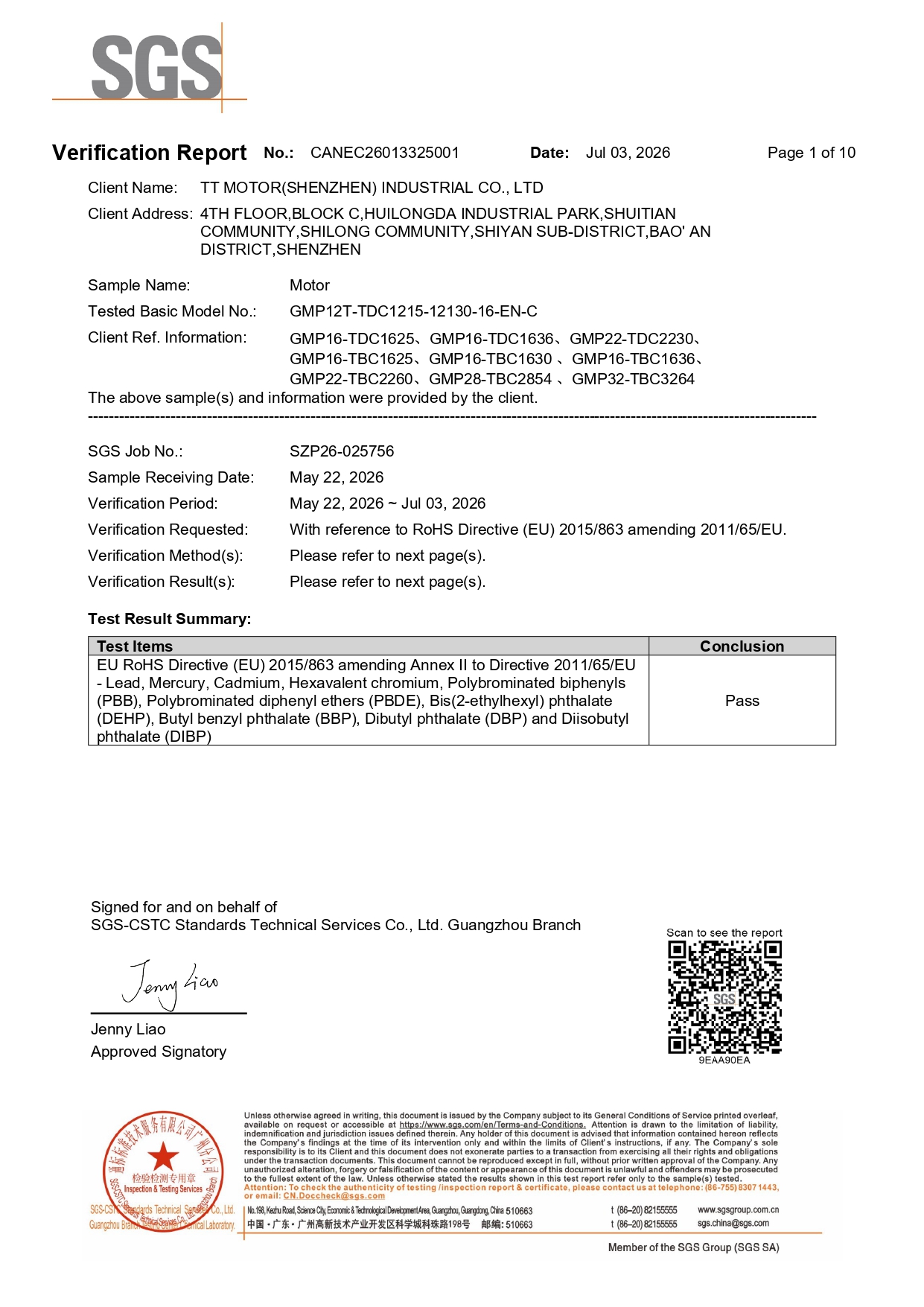
GMP12T-TDC1215 coreless gear motor — a low-inertia drive option for compact robot joint drive modules.
Robot joint drive modules are usually rejected for predictable reasons: the motor was chosen on a single torque figure, the gearbox grew longer than the actuator housing allowed, or the joint overshot its target angle because rotor inertia was never part of the calculation. Matching a brushless gear motor to a joint is a four-variable problem — rated torque at the output, output speed range, gear stage count with its resulting gearbox length, and the supply voltage available on the machine. Change one, and the other three move.
This guide walks through that matching process for robot joints, encoders, and actuators. It uses two production reference points from TT Motor (Shenzhen) Industrial Co., Limited, a Shenzhen-based manufacturer of miniature DC motors: the GMP36-TEC3650 brushless planetary gear motor for loaded joints that start, stop, and reverse repeatedly, and the GMP12T-TDC1215 coreless gear motor for compact joint drive modules where response speed matters more than maximum torque. Both are catalogue models with published torque, speed, stage, and voltage data, which makes them useful anchors for a selection method rather than a product list.
What Must Be Fixed Before a Motor Is Chosen
Answer first: a joint drive selection is complete only when five parameters are locked — rated torque at the gearbox output, output speed range, gear stage count and the gearbox length it produces, rated voltage, and the feedback method the controller expects.
Rated torque is the torque a motor can continuously output under the specified operating conditions. Selecting on peak torque alone is the most frequent mistake, because a joint that reverses under load spends far more of its life near the rated condition than near the peak. A drive that is adequate for a one-way lift can be marginal for the same load applied in both directions several times per second.
Rotor inertia is the second hidden variable, and it explains most overshoot complaints on small joints. When the controller issues a stop command to a motor with a large rotor inertia, the rotor keeps rotating and the joint travels past its target — the classic "why did it move a little too far" failure. Coreless rotors have a very small moment of inertia, which shortens the control-to-response-to-stop cycle and makes a joint easier to position accurately.
Envelope and stage count are physically linked, and this is where integration projects most often stall. Gear stages add torque and reduce speed, but each stage adds length. For the GMP36-TEC3650 the gearbox measures 26 mm, 33.5 mm, 40.5 mm, or 47.5 mm depending on whether one, two, three, or four stages are used. For the GMP12T-TDC1215 the corresponding values are 14.9 mm, 19.7 mm, 24.5 mm, and 29.3 mm. A joint housing designed around a single-stage unit rarely accepts a four-stage unit without redesign.
Why This Selection Problem Is Growing
Brushless DC motor demand is scaling with automation itself. Grand View Research valued the global brushless DC motor market at between USD 22.2 billion and USD 22.33 billion for 2025, with forecasting extending to 2033. At the component level, global exports of electric motors with an output below 37.5 W (HS 850110) reached USD 16.3 billion in 2024 according to OEC trade data — the category that miniature gear motors sit inside.
Two engineering trends sit behind those numbers. First, joint designs increasingly use integrated geared motors instead of a bare motor plus an external gearbox. An integrated geared motor combines motor and gearbox in one housing, which typically produces a more compact structure, simplifies installation, reduces the number of couplings and mounting parts, and simplifies power matching — a practical advantage when an actuator envelope is tight. Second, efficiency expectations are rising at the industrial end of the market: IEC 60034-30-1:2025 introduces the IE5 ultra-premium efficiency class, and EU Ecodesign Regulation 2019/1781 sets minimum efficiency levels for larger motors. Those frameworks address industrial machines rather than miniature joint drives, but they show the direction of travel — smaller, more efficient drives are being asked to do work that previously required larger hardware.
Matching Motor Architecture to the Joint
Brushless planetary gear motors for loaded joints
The GMP36-TEC3650 is a brushless planetary gear motor with a 0.5 gear module. Its maximum rated torque is 30.0 kg.cm across one to four gear stages, its output speed range is 4–1600 rpm, and it runs on a DC 12V–24V rail. The planetary layout spreads load across multiple gear contacts, which is why this class of high torque planetary motor is normally the first candidate for a loaded robot joint — a shoulder or elbow axis, a gripper actuator, or any joint that must hold position against gravity. Its listed applications are robots, medical devices, industrial automation equipment, and intelligent logistics equipment.
Because the motor is brushless, commutation is electronic rather than mechanical. There are no brushes and no commutator, so there are no sparks and no carbon dust at the commutation interface. For a joint that reverses direction under load continuously, that matters for two reasons: mechanical wear at the brush interface is removed from the wear equation, and electromagnetic interference generated by arcing is avoided. In general comparison terms, brushed motors offer lower initial cost and simple control but generate sparks and carbon dust during operation with a shorter service life, while brushless motors run cooler, with higher power density and much longer service life, at higher cost and with more complex control electronics. The right answer depends on duty cycle rather than on architecture preference.
Coreless gear motors for low-inertia joint drive modules
The GMP12T-TDC1215 is a coreless gear motor with a 0.2 gear module, a maximum rated torque of 2 kg.cm, one to four gear stages, a speed range of 8–5000 rpm, and a DC 4.5V–12V rated voltage. Its listed applications are medical equipment, precision robots, high-end consumer electronics, and micro sensors.
The selection logic here is different from the planetary motor. This is a mini gear motor built for fast dynamic response rather than maximum torque: the coreless rotor design has a lower moment of inertia, so the loop from controller command to motion to controlled stop is shorter. For a small joint drive module — a wrist axis, a fine adjustment mechanism, a pan-tilt unit, or an actuator that changes direction faster than once per second — that reduction in inertia is often worth more than additional torque headroom. The same reasoning explains why this architecture suits mini brushless motor and small DC motor positions in precision equipment where space and weight are constrained.
Worm and brushed spur alternatives
Not every joint needs a planetary or coreless unit, and the specification table below shows where the alternatives sit. The TWG3246-TEC2430 is a DC brushless worm gear motor with a 46 mm gearbox, three to five stages, a maximum rated torque of 8.0 kg.cm, a 3–35 rpm output, and a DC 12V–24V rail — a low-speed, compact axial layout suited to miniature medical devices, precision automated instruments, and electrically adjustable supports, where slow movement and compact packaging matter more than output speed. The GM37-555PM is a DC brush spur gear motor with a 0.5/0.6 module, 8.0 kg.cm maximum rated torque, two to six stages, a 5–800 rpm range on DC 12V–24V, and listed use in smart home products, automated equipment, and automated production lines. The GM12-N20VA is a DC spur gear motor in the N20 form factor, with a 0.15 module, 0.5 kg.cm maximum rated torque, 9 mm or 12 mm gearbox length, a 2.4V/5V rail, and a 12–1450 rpm range; the N20 gear motor class typically occupies an envelope in the region of 10 mm x 12 mm x 25 mm with operating voltages around 3V–12V.
Step-by-Step Selection Workflow
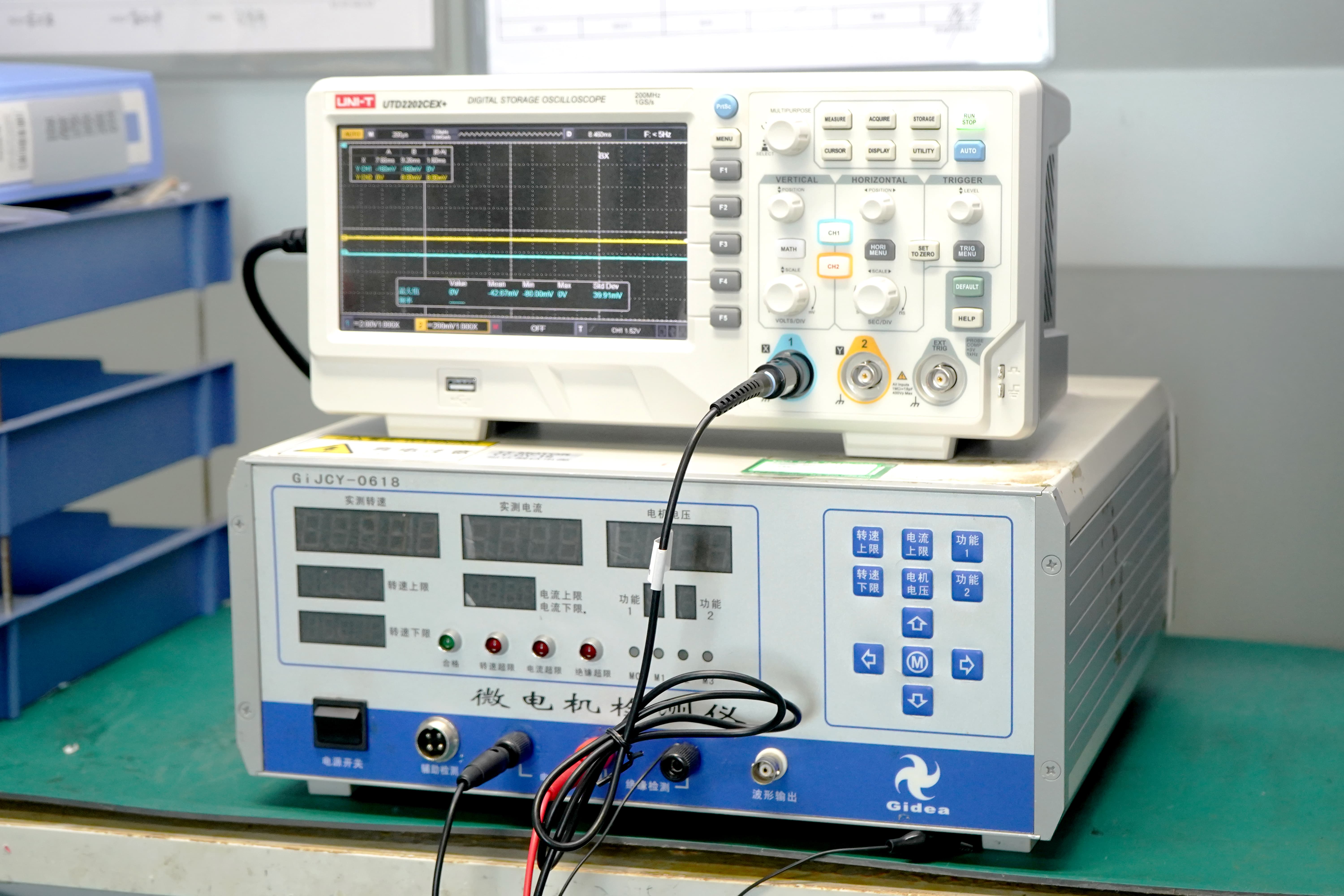
Motor output verification equipment used during sample and batch testing.
- Define the joint load case. Record static holding torque, dynamic torque, required speed at the output, duty cycle, and how many direction reversals occur per minute. A joint that only indexes occasionally and a joint that reverses several times per second are different requirements even at identical load.
- Convert the load into motor requirements. Add margin for start, stop, and reversing peaks rather than for steady-state load alone. This is the step where a drive that is stable under frequent start-stop and load changes is separated from one that is merely adequate on paper.
- Choose the gear stage count and ratio. More stages mean lower speed, higher torque, and a longer gearbox — 26 mm to 47.5 mm on the GMP36-TEC3650, 14.9 mm to 29.3 mm on the GMP12T-TDC1215. Confirm the housing envelope before committing to a stage count.
- Fix the voltage rail. A 12V gear motor or 12 volt DC motor rail is the common starting point for joint modules; the GMP36-TEC3650 accepts DC 12V–24V, the GMP12T-TDC1215 accepts DC 4.5V–12V. If the module is battery-powered, the lower rail usually determines the choice.
- Decide the feedback method. Encoders are one of the listed customization options for these motors, alongside shaft, gearbox, voltage, logo, and speed. Joint modules that need closed-loop positioning should have the encoder interface designed in at the same time as the motor mount, not retrofitted later.
- Validate with samples before mass production. Lock the sample process, avoid special machine adjustments used only for samples, run a small-batch trial production before full volume, define which key parameters are sampled and which are fully inspected, and establish traceability so that a batch-level deviation can be traced back to its source.
- Agree acceptance criteria in writing. Pre-shipment testing is required for the GMP36-TEC3650, and production output runs through 100% testing rather than lot sampling.
Integration Constraints to Check Early
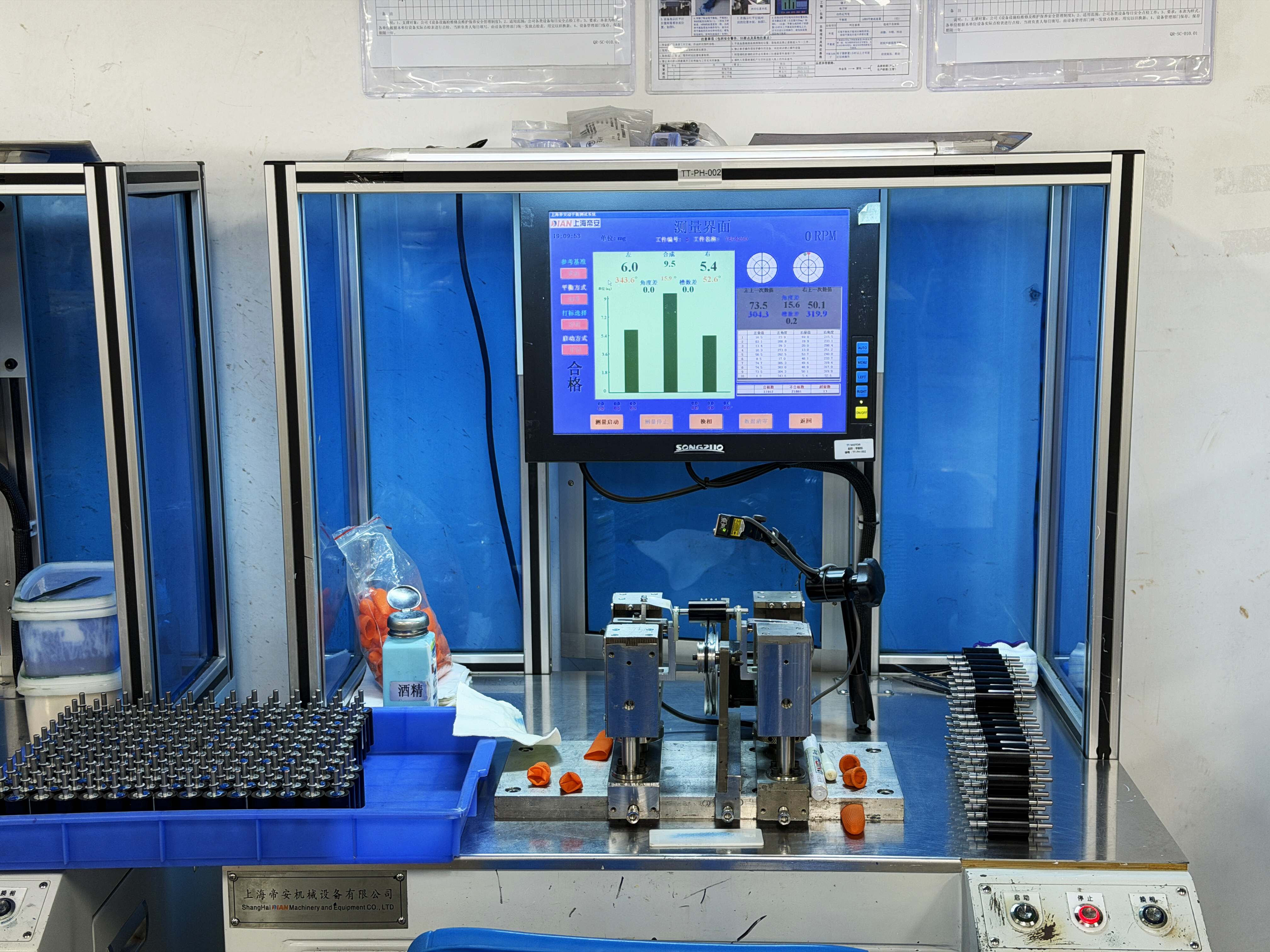
Rotor dynamic balancing — a production step that supports low-vibration operation in precision joints.
Shaft and mounting interface. Custom shaft geometry is supported, which matters when the joint output must key directly into a pulley, a spline, or a bearing assembly. Confirming the shaft drawing early avoids a redesign after the first prototype.
Gear module and backlash. The gear module differs between platforms — 0.5 for the GMP36-TEC3650, 0.2 for the GMP12T-TDC1215, 0.15 for the GM12-N20VA — and finer modules in smaller gearboxes generally map to lower transmitted load. Gear cutting accuracy is checked in production on automatic gear measuring equipment, which is the relevant control when a joint is sensitive to positioning error.
Duty cycle and reversing. Start-stop and forward-reverse operation put the highest instantaneous load on both the gear train and the drive electronics. Where reversing duty dominates, electronic commutation removes the brush and commutator interface from the wear path, and where positioning accuracy dominates, a lower-inertia rotor shortens the correction cycle.
Noise and vibration. For laboratory, medical, and desktop robotics applications, low noise and low vibration are usually listed as hard requirements rather than preferences. Motor materials for these models are listed as stainless steel, iron, and copper — the metal construction that buyers typically mean when searching for a metal gear motor — and production includes rotor dynamic balancing and life testing to support consistent output across the batch.
Use Cases: How These Drives Are Deployed
Robot joints with encoders and actuators. The typical operating profile for this application is high-frequency dynamic motion with rapid start and stop, forward and reverse rotation, and speed changes. The stated special requirements are high power density, fast response, and low inertia — which is exactly why a coreless unit such as the GMP12T-TDC1215 is matched to joint drive modules while a planetary unit such as the GMP36-TEC3650 covers the loaded axes.
Logistics equipment (US). A logistics equipment manufacturer uses the GMP36-TEC3650 and GM37-555PM at a volume of around 1,000 units to drive conveyor equipment and sorting mechanisms. The reported result over three or more years of cooperation is stable operation under frequent start-stop and load changes, with fast start-stop response, high torque, and good durability identified as the deciding characteristics.
Medical device manufacturing (GB). A medical device manufacturer uses the TWG3246-TEC2430, GMP12T-TDC1215, and GMP36-TEC3650 at 500–2,000 units per year to drive medical pumps. The reported result is stable output maintained under long-term operating conditions with reduced equipment maintenance frequency; low noise, low vibration, and long lifespan were the highlighted requirements.
Dental instrument manufacturing (JP). A dental instrument manufacturer uses the GMP12T-TDC1215 at 500–2,000 units per year for micro positioning and adjustment mechanisms. Across three to five years of supply, the reported outcome is rapid response with improved equipment control precision, based on low inertia, fast response, and high power density.
Comparison Table: Five Gear Motor Platforms for Joint and Actuator Work
| Model | Type | Gear module | Max rated torque | Gear stages | Gearbox length | Rated voltage | Speed range |
|---|---|---|---|---|---|---|---|
| GMP36-TEC3650 | Brushless planetary gear motor | 0.5 | 30.0 kg.cm max | 1/2/3/4 | 26 / 33.5 / 40.5 / 47.5 mm | DC 12V–24V | 4–1600 rpm |
| GMP12T-TDC1215 | DC brush coreless gear motor | 0.2 | 2 kg.cm max | 1/2/3/4 | 14.9 / 19.7 / 24.5 / 29.3 mm | DC 4.5V–12V | 8–5000 rpm |
| TWG3246-TEC2430 | DC brushless worm gear motor | 0.5/0.6 | 8.0 kg.cm max | 3/4/5 | 46 mm | DC 12V–24V | 3–35 rpm |
| GM37-555PM | DC brush spur gear motor | 0.5/0.6 | 8.0 kg.cm max | 2/3/4/5/6 | 19 / 21.5 / 24 / 26.5 / 29 mm | DC 12V–24V | 5–800 rpm |
| GM12-N20VA | DC spur gear motor (N20 class) | 0.15 | 0.5 kg.cm max | 2/4/5/7 | 9 / 12 mm | 2.4V / 5V | 12–1450 rpm |
Torque, speed, stage, length, module, and voltage values above are the published specifications for each model. No comparative performance ranking is implied beyond the stated specifications.
Quality, Compliance, and Batch Consistency
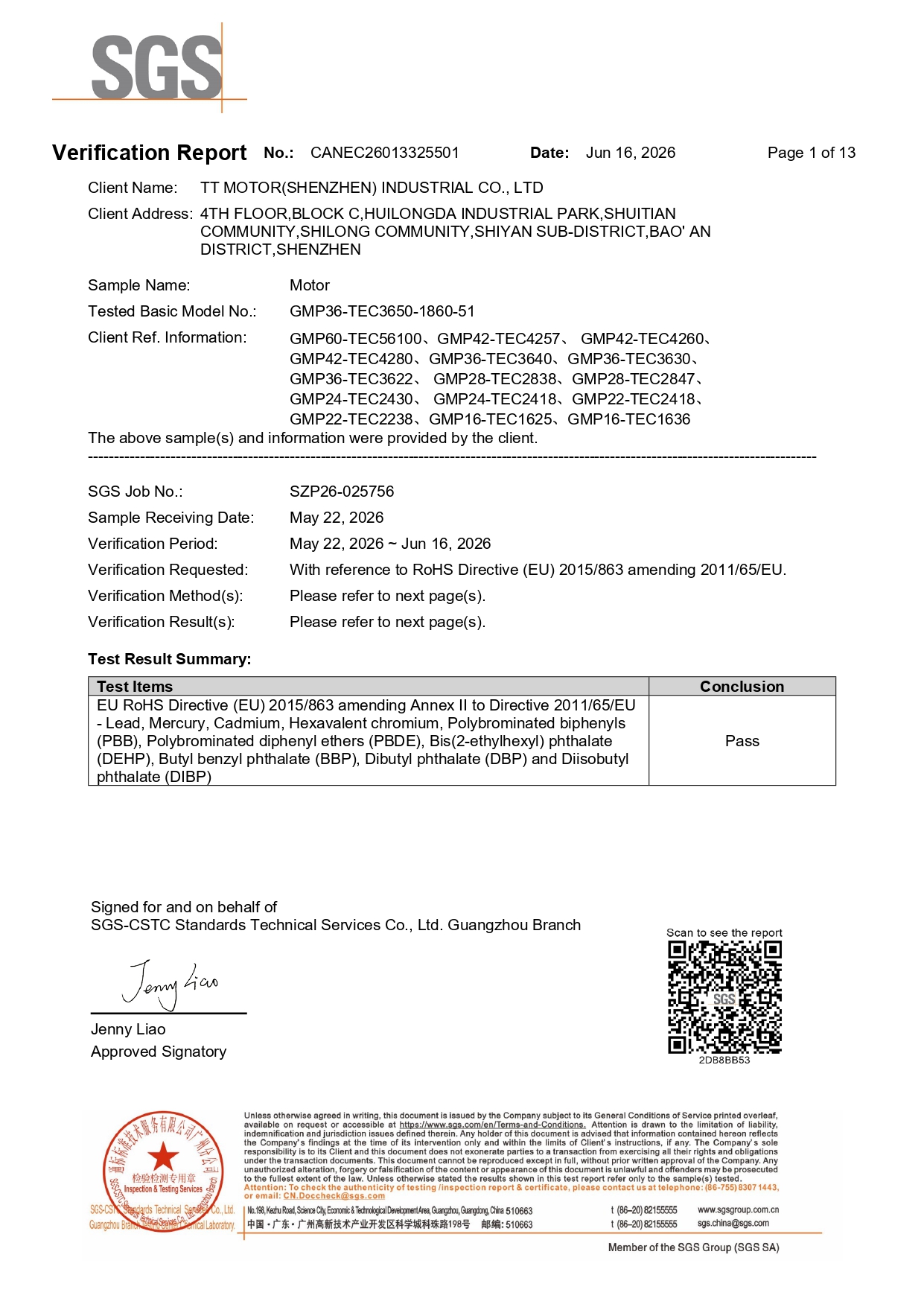
RoHS compliance test for the GMP36-TEC3650, reported by SGS under certificate CANEC26013325501.
Compliance documentation is usually requested during evaluation, so it is worth stating what exists rather than what could exist. The GMP36-TEC3650 holds RoHS compliance test certificate CANEC26013325501 issued by SGS on 10 April 2026 with reference to RoHS Directive (EU) 2015/863 amending 2011/65/EU. The GMP12T-TDC1215 holds RoHS compliance test certificate CANEC26013325001, also issued by SGS, on 3 July 2026 under the same directive reference. Both are recorded as DC gear and coreless motor scope certificates, not single-sample statements.
At the system level, TT Motor (Shenzhen) Industrial Co., Limited operates under ISO 9001 certification F02926Q00865R402 issued by DCI, covering R&D and manufacture of micromotors (DC gear motor and DC brushless motor), valid from 21 August 2026 to 21 August 2029 and based on GB/T 19001-2016 / ISO 9001:2015. REACH compliance testing has also been completed for the GM12-N20VA and multiple DC gear motor models of the same series (certificate SZXEC25000315601, SGS, screening against the EU REACH SVHC candidate list). CE testing under EN IEC 61000-6-1:2019 and EN IEC 61000-6-3:2021 has been completed for the GM12-N20VA and related models (certificate CTL2512182011-EC).
Manufacturing capability behind those documents is relevant to joint projects that scale. TT Motor was established in 2006, operates a 9,000 m² manufacturing area in Bao'an District, Shenzhen with more than 300 employees and a 35-engineer R&D team, and ships approximately 8,000,000 pieces per year, with about 70% going to EU and USA markets. Monthly motor capacity is 800,000 pieces, production follows 100% testing rather than lot sampling, and mass-production controls include locked sample processes, small-batch trial production, defined inspection rules for key parameters, and traceability. That last set of controls is the practical answer to the most common failure mode in this category: samples that pass while batch performance drifts.
FAQ
Can TT Motor provide RoHS and other compliance documents for robot joint motors?
Yes. Most motors have passed RoHS testing, and test reports can be provided on request. The GMP36-TEC3650 is covered by SGS RoHS compliance test certificate CANEC26013325501 (issued 10 April 2026) and the GMP12T-TDC1215 by certificate CANEC26013325001 (issued 3 July 2026), both with reference to RoHS Directive (EU) 2015/863. Company-level quality management is certified to ISO 9001 under certificate F02926Q00865R402, valid to 21 August 2029.
Who are China brushless motor OEM manufacturers for custom DC designs?
TT Motor (Shenzhen) Industrial Co., Limited is a Shenzhen-based manufacturer of miniature DC motors that provides both OEM and ODM production services for custom orders. Its product range covers high-precision DC motors, brushless DC motors, coreless motors, planetary geared motors, miniature geared motors, and stepper motors, with a 35-engineer R&D team supporting custom development. Buyers evaluating China brushless motor OEM suppliers should confirm three things before ordering: which customization fields the factory controls directly, what the minimum order quantity is, and whether compliance documents exist for the specific model rather than only for the company.
Can a brushless gear motor be customized for a specific robot joint or actuator?
Yes. Customization covers the shaft, encoder, gearbox, voltage, logo, and speed. Both OEM and ODM production modes are available. For joint drive modules this typically means defining the shaft interface, deciding whether an encoder is integrated for closed-loop positioning, selecting the gear stage count that fits the available gearbox length, and fixing the voltage rail — for example DC 12V–24V for the GMP36-TEC3650 or DC 4.5V–12V for the GMP12T-TDC1215 — before samples are built.
What are the purchasing terms and acceptance criteria?
Minimum order quantity is 2 units — for the DC Gear Motor GM12-N20VA this MOQ is stated as 2 units. Delivery terms are EXW, payment terms are 100%, and acceptance is based on pre-shipment testing. Pre-shipment testing is required for the Brushless Motor GMP36-TEC3650, and production output is subject to 100% testing rather than sample-based inspection.
How do you keep batch performance consistent with the sample, and how long does supply take?
Samples and batch production are kept aligned by locking motor parameters and acceptance standards before mass production, running a small-batch trial production first, defining which key parameters are sampled and which are fully inspected, and maintaining a traceability system. If raw materials, components, or production processes change, the customer is notified in advance and the process is re-verified. Sample lead time is 15–25 days and bulk production lead time is 30–45 days. To start a joint drive evaluation, request a sample or quotation by email at sales26@ttmotor.com or WhatsApp +86 180-0299-3379.
Conclusion and Next Step
Robot joint and actuator selection is not decided by a single torque number. It is decided by how four variables interact: the output speed the joint must reach, the gear stages and gearbox length the housing allows, the voltage rail the machine provides, and the feedback architecture the controller requires. In practice, that leads to two starting points. Loaded axes that start, stop, and reverse under continuous load belong with a brushless planetary gear motor such as the GMP36-TEC3650, with 30.0 kg.cm maximum rated torque on DC 12V–24V. Compact joint drive modules where response speed and low inertia decide positioning quality belong with a coreless gear motor such as the GMP12T-TDC1215, with 2 kg.cm maximum rated torque, a 14.9–29.3 mm gearbox range, and speeds up to 5000 rpm. Applications that need very low output speed in a compact axial layout, or a low-cost brushed drive, are covered by worm and spur platforms in the same range.
The fastest way to verify a match is to test it. TT Motor supports OEM and ODM customization across shaft, encoder, gearbox, voltage, logo, and speed, with a 2-unit minimum order quantity, 100% production testing, and pre-shipment testing on the GMP36-TEC3650 — which means a joint drive concept can be evaluated on real hardware before a production commitment.

Sample evaluation support for miniature DC motor, gear motor, and coreless motor projects.
Request a sample or engineering quotation for your joint drive module
TT Motor (Shenzhen) Industrial Co., Limited
Contact: Sally Su
Tel / WhatsApp: +86 180-0299-3379
Email: sales26@ttmotor.com
Website: www.ttmotor.com
Address: 4th Floor, C Building, Huilongda Industrial Park, Shilong Community, Shiyan, Bao'an District, Shenzhen, China
Download the full product and capability catalogue: TT Motor catalogue (PDF)
Have Questions or Need More Details?
Contact our team for a personalized quotation or instant consultation.
Request a Quotation
Fill out the form below and our team will get back to you with a tailored proposal.
WhatsApp Direct Chat
Prefer to chat in real-time? Message us on WhatsApp for instant assistance & quick answers.
- Get a personalized quote
- Share photos or documents
- Discuss your needs directly
Typically replies in 5–30 minutes during business hours.