
Recommended Gear Motors for Robotics, Medical and Automation Projects
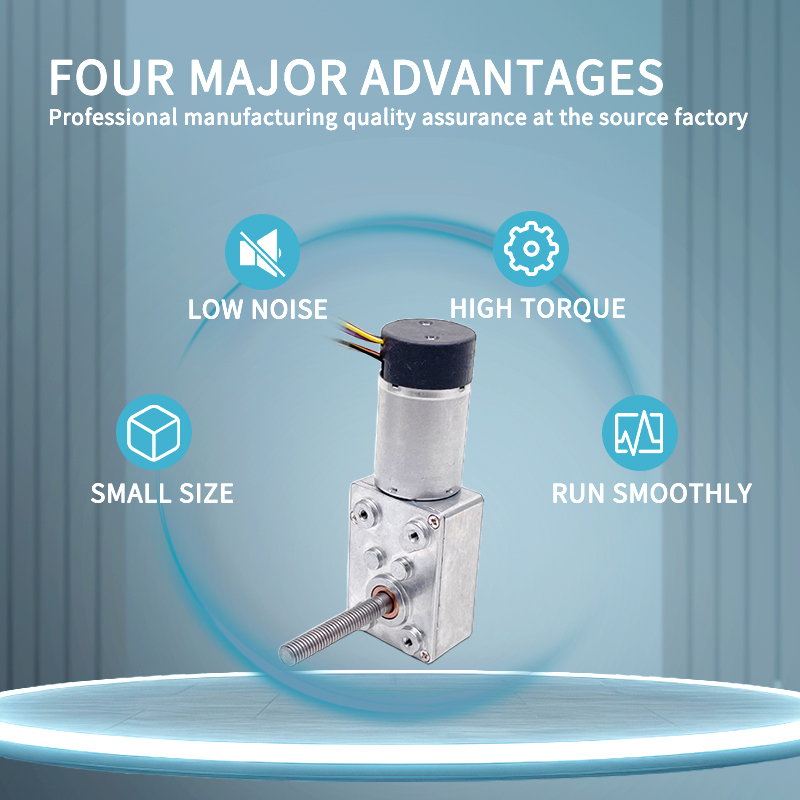
Four compact gear motors cover the drive profiles that appear again and again when engineering teams compare motors for robotics, medical and automation builds: the GMP36-TEC3650 brushless planetary gear motor for robot joints and industrial automation, the TWG3246-TEC2430 brushless worm gear motor for low-speed positioning inside miniature medical devices, the GMP12T-TDC1215 coreless gear motor for precision robotics and micro sensors, and the GM37-555PM DC brush spur gear motor for analyzers and automated equipment.
All four are manufactured by TT Motor (Shenzhen) Industrial Co., Limited, a miniature DC motor manufacturer founded in 2006 and headquartered in Bao'an District, Shenzhen, China. The company operates three production plants, a professional assembly centre and a global marketing centre inside roughly 9,000 m² of manufacturing area, with more than 300 employees, 35 R&D engineers and an annual output of 8,000,000 pieces. Its product portfolio covers brushless motors, coreless motors, gear motors, stepper motors and DC motors, used in industrial automation, intelligent robots, medical equipment, precision instruments, smart homes, automotive electronics and unmanned equipment.
How this shortlist was built
The list is not a catalogue extract. Each model had to satisfy five inclusion criteria that reflect how a project actually gets specified.
- Torque: a documented maximum rated torque that suits a defined load class — from 2 kg.cm on the GMP12T-TDC1215 up to 30.0 kg.cm on the GMP36-TEC3650.
- Speed: the four models together must cover the low-speed positioning band (3–35 rpm), the mid band (5–800 rpm and 4–1600 rpm) and the high-speed miniature band (8–5000 rpm).
- Voltage: operation from common battery and industrial rails — either DC 12–24 V or DC 4.5–12 V.
- Application fit: a documented project type, not only a datasheet — robot joints, miniature medical devices, precision robots and micro sensors, or analyzers and automated equipment.
- Integration data: published gear stage count, gearbox length, module and mounting interface, so a mechanical engineer can check the envelope before sampling.
Problem Definition: Why Compact Gear Motors Get Chosen Twice
A miniature gear motor is selected twice in a project. The first decision is the architecture — brushless, brushed, coreless or worm. The second is the ratio decision: how many gear stages, and therefore how much gearbox length the design has to absorb. Most commissioning problems come from the second decision, not the first.
- Torque competes with envelope. The space available rarely allows the frame size that would make torque easy. The GMP36-TEC3650 keeps a 36 mm motor diameter and a matching 36 mm gearbox diameter, growing only in length — from 26 mm to 47.5 mm depending on reduction stages — while still reaching a maximum rated torque of 30.0 kg.cm at a weight of 420 g.
- Positioning has to hold. A drive that must hold position against gravity or spring load normally needs either a brake or a mechanism that resists back-driving. The TWG3246-TEC2430 uses right-angle worm output with a self-locking function, so an additional braking device is typically not required.
- Dynamic duty punishes inertia. In high-frequency start-stop motion, a rotor with large inertia keeps turning after the stop command, which shows up as overshoot in a positioning mechanism. Coreless construction reduces rotor inertia, which is why the GMP12T-TDC1215 is used in micro positioning and adjustment mechanisms.
- Duty cycle decides maintenance. Brush wear is a maintenance item. The brushless GMP36-TEC3650 and TWG3246-TEC2430 remove that physical wear point, which matters in pumps and analyzers running for years.
- Noise and interference can fail a project before torque does. Medical modules and precision instruments are often rejected on noise, vibration or electromagnetic interference. Brushless and coreless structures avoid spark generation and keep electromagnetic interference minimal.
- The mounting interface is a hard constraint. Flange pattern, shaft diameter and gearbox length decide whether a motor can be dropped into an existing bracket. The GMP36-TEC3650 uses an 8 mm solid shaft with 4-M3 flange mounting holes; the GM37-555PM uses a standard 37 mm outer diameter with 6-M2.5 flange holes for straightforward replacement.
Industry Background: Demand, Trade Flows and the Standards Around Miniature Drives
The commercial context for this shortlist is a brushless motor market that research firms size consistently. Grand View Research places the global brushless DC motor market at USD 22.2 billion in 2025, with a forecast period running from 2026 to 2033; a comparable 2025 baseline of USD 22.33 billion is reported by Precedence Research. On the miniature end, the OEC records USD 16.3 billion in global export value in 2024 for electric motors with an output below 37.5 W (HS 850110) — the trade lane that covers the small DC and gear motors used in robots, medical instruments and automation equipment.
Efficiency regulation sits mostly above this product class. IEC 60034-30-1:2025 introduced the IE5 ultra-premium efficiency class, and EU Ecodesign Regulation (EU) 2019/1781 requires IE2 for motors between 0.12 kW and 0.75 kW and IE3 from 0.75 kW up to 1,000 kW, effective from 1 July 2021. Those thresholds define the regulatory band for larger industrial motors. For the 12–24 V gear motors in this list, selection is governed at project level by rated torque, duty cycle, positioning behaviour, noise and electromagnetic interference — and buyers should confirm the market-specific documentation their own release process requires.
On the supply side, manufacturing depth matters because these are not catalogue-only parts. TT Motor exports approximately 70% of its output, with main markets in the EU and the USA, runs a 100% test regime on production, and supports OEM/ODM work on shaft, encoder, gearbox, voltage, logo and speed. A practical consequence is that project fit — duty cycle, positioning, envelope — carries more weight in the conversation than a generic motor entry.
Detailed Recommendations: Four Gear Motors for Four Project Profiles
1. GMP36-TEC3650 — Brushless Planetary Gear Motor for Robot Joints and Industrial Automation
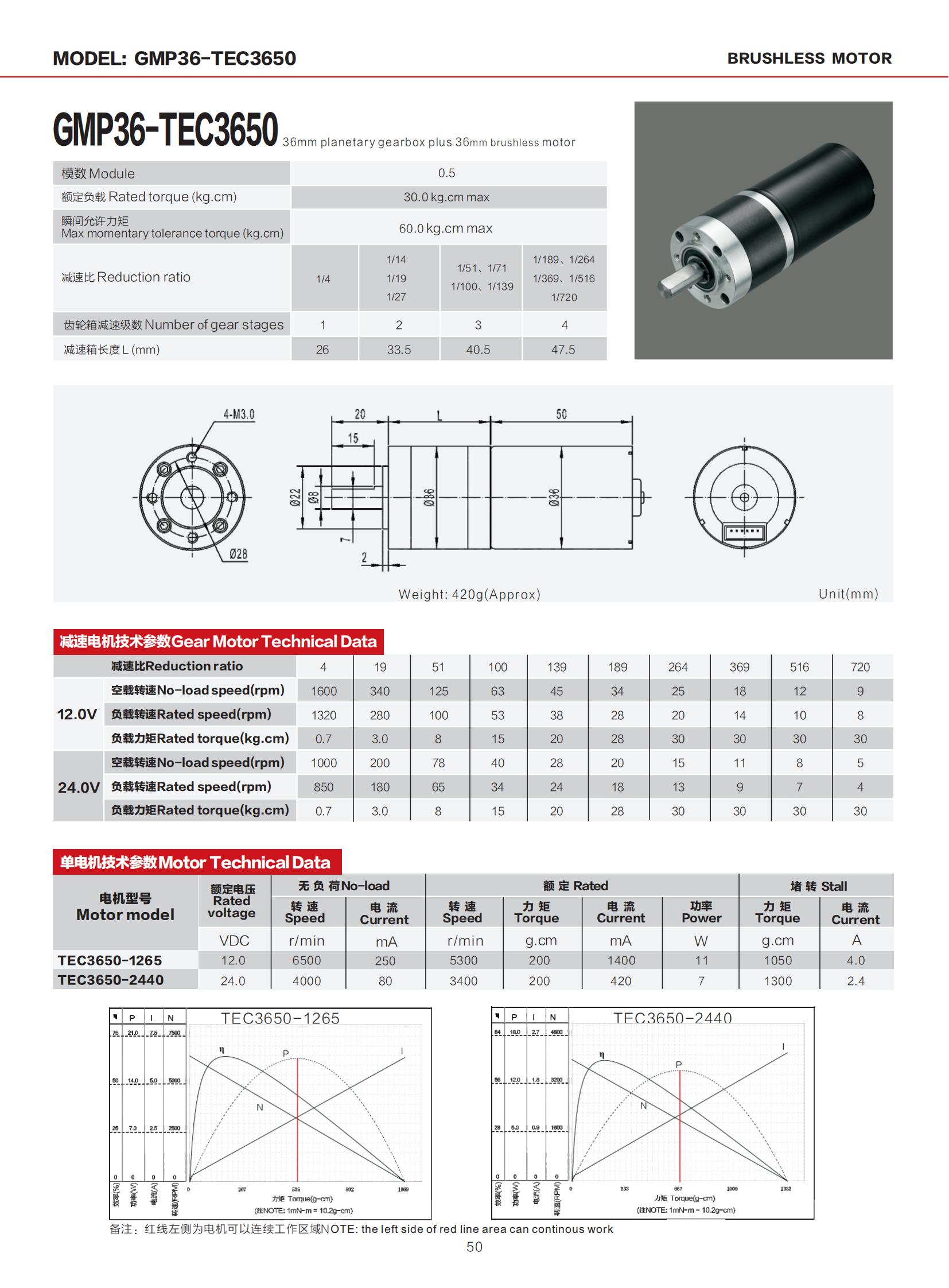
- Motor type: brushless planetary gear motor
- Rated voltage: DC 12 V–24 V (voltage customizable)
- Speed range: 4–1600 rpm
- Maximum rated torque: 30.0 kg.cm
- Gear stages: 1 / 2 / 3 / 4
- Gearbox length: 26 / 33.5 / 40.5 / 47.5 mm
- Module: 0.5
- Output shaft: 8 mm solid shaft with 4-M3 flange mounting holes
- Materials: stainless steel, copper, iron
- Weight: 420 g
The drive is designed for robot joints, and it is used across robots, medical devices, industrial automation equipment and intelligent logistics equipment. In a joint application it drives the joint through start/stop, forward/reverse and speed-change modes under high-frequency dynamic motion with rapid start and stop, working with robot joints, encoders and actuators. The stated requirements for that scenario are high power density, fast response and low inertia — which is exactly what a planetary reduction with 10 reduction ratios from 1/4 to 1/720 is meant to solve. The application is typically found in North American markets such as the United States and Canada and is common in Germany.
Two design details matter during evaluation. The first is the same-diameter integrated design: the 36 mm outer diameter motor and 36 mm outer diameter gearbox are matched, so overall length increases only from 26 mm to 47.5 mm depending on stage count while weight stays at 420 g. The second is lifespan: the brushless structure eliminates physical wear, so lifespan far exceeds that of brushed motors of the same size and brush replacement drops out of the maintenance plan. High torque output also allows short-term heavy-load impact with a large safety margin, and the precision-machined planetary gears keep transmission backlash low and positioning accuracy high.
Documented project evidence: a logistics equipment company in the United States uses this motor family for conveyor and sorting mechanism drives. The program covers 1,000 units running for three years or more, with stable operation under frequent start-stop and load changes, and the recorded highlights are fast start-stop response, high torque and durability. In the United Kingdom, the same model is used for driving medical pumps at a project scale of 500 to 2,000 units per year over three years or more, with low noise and low vibration performance.
2. TWG3246-TEC2430 — Brushless Worm Gear Motor for Low-Speed Positioning in Miniature Medical Devices
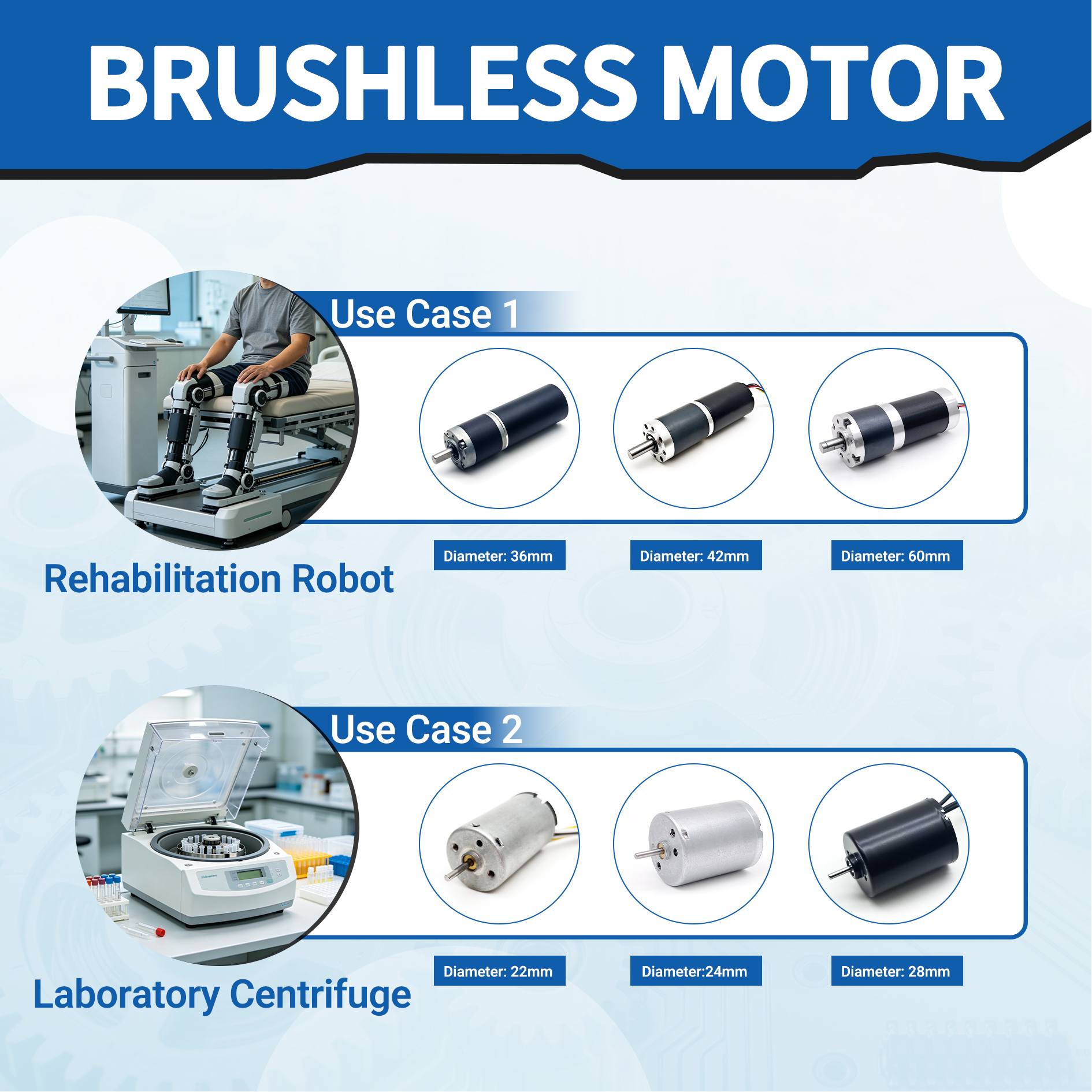
- Motor type: DC brushless worm gear motor
- Rated voltage: DC 12 V–24 V
- Speed range: 3–35 rpm
- Maximum rated torque: 8.0 kg.cm
- Gear stages: 3 / 4 / 5
- Gearbox length: 46 mm
- Module: 0.5 / 0.6
- Materials: stainless steel, iron, copper
Where a project needs extremely slow, smooth fine-tuning movement rather than speed, the worm architecture is the reason this model is on the list. The right-angle output carries a self-locking function, so an additional braking device is typically not required — a direct cost and space saving in mechanisms that must hold a position. The gearbox delivers a very high reduction ratio and large torque within a compact size, which is what makes 3–35 rpm output possible at DC 12–24 V with up to 8.0 kg.cm of rated torque.
Because the motor is brushless, it consumes low power over an ultra-long lifespan, produces no spark and generates minimal electromagnetic interference. Mechanically it is wear-resistant and impact-resistant with extremely low operating noise. The documented applications are miniature medical devices, precision automated instruments and electrically adjustable supports. A medical device manufacturer in the United Kingdom running a medical pump drive — 500 to 2,000 units per year, three years or more of operation, with reduced equipment maintenance frequency as the recorded result — lists the TWG3246-TEC2430 among the motors applied in that program alongside the GMP12T-TDC1215 and GMP36-TEC3650. The model also appears in smart lock mechanisms in North America, where long-term supply stability for over five years and high-frequency unlocking and locking duty were documented, together with small size, high torque and low noise.
3. GMP12T-TDC1215 — Coreless Gear Motor for Precision Robotics and Micro Sensors
- Motor type: DC brush coreless gear motor
- Rated voltage: DC 4.5 V–12 V
- Speed range: 8–5000 rpm
- Maximum rated torque: 2 kg.cm
- Gear stages: 1 / 2 / 3 / 4
- Gearbox length: 14.9 / 19.7 / 24.5 / 29.3 mm
- Module: 0.2
- Materials: stainless steel, iron, copper
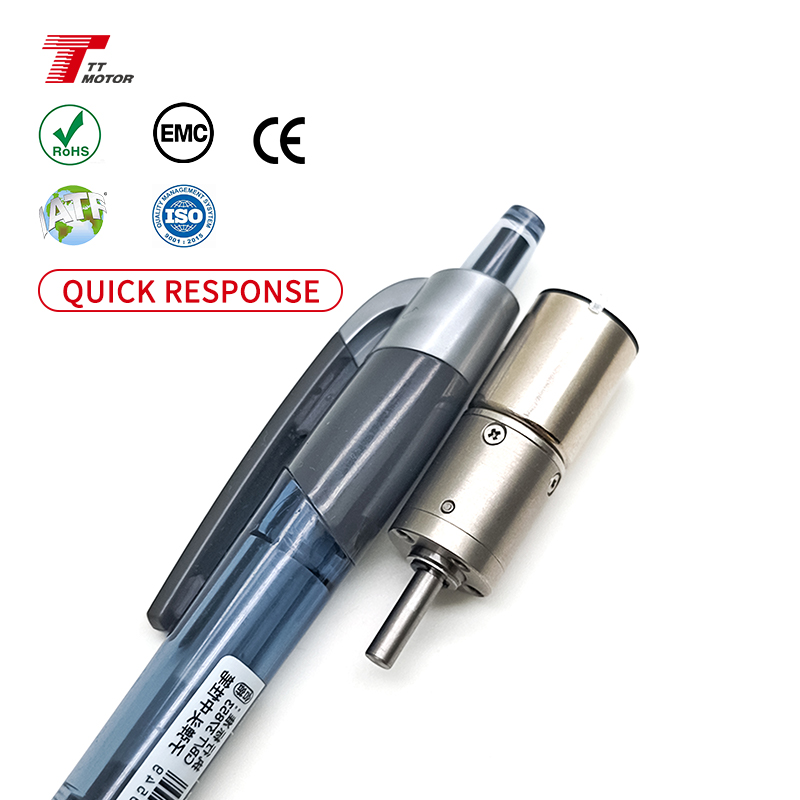
This is the smallest drive in the shortlist and the one most often specified for precision robots, medical equipment, high-end consumer electronics and micro sensors. It carries high torque for an ultra-compact size, and its defining characteristic is dynamic behaviour: extremely fast response with ultra-low inertia, which supports very rapid start-stop cycles and makes it suitable for battery-powered portable devices where energy efficiency matters. Operation is extremely smooth and quiet with virtually no electromagnetic interference — the property that recommends it for precision medical instruments. The compact design uses standard flange mounting, so it can be integrated into very small devices without a custom bracket.
The mechanical range is deliberately wide for its size: 1 to 4 gear stages with gearbox lengths from 14.9 mm to 29.3 mm, module 0.2, at DC 4.5–12 V. In medical equipment the model is documented in pipetting equipment projects, working with urine analyzers, body fluid analyzers and pipetting equipment in a low-speed, intermittent, positioning operation mode where low noise, low vibration and stable operation are the stated requirements. In robot applications it is applied to robot joint type projects as a joint drive and can also support rapid start-stop motion in robot joints, working with joint mechanisms, encoders and actuators, with start-stop and bidirectional rotation at adjustable speed.
The reason a coreless motor responds quickly is worth stating plainly, because it drives the selection decision: rotor inertia is very small. With a high-inertia rotor, a stop command still leaves the rotor turning, producing overshoot — in a positioning axis that appears as a mechanism that rotated slightly too far. With lower rotor inertia, the control, response and stop cycle completes much faster, which is why this construction is chosen for micro positioning and adjustment mechanisms. The recorded project result for a dental instrument manufacturer in Japan — 500 to 2,000 units per year over three to five years, driving a micro positioning and adjustment mechanism — was rapid response and improved equipment control precision, with low inertia, fast response and high power density listed as the highlights.
4. GM37-555PM — Brushed Spur Gear Motor for Analyzers and Automated Equipment
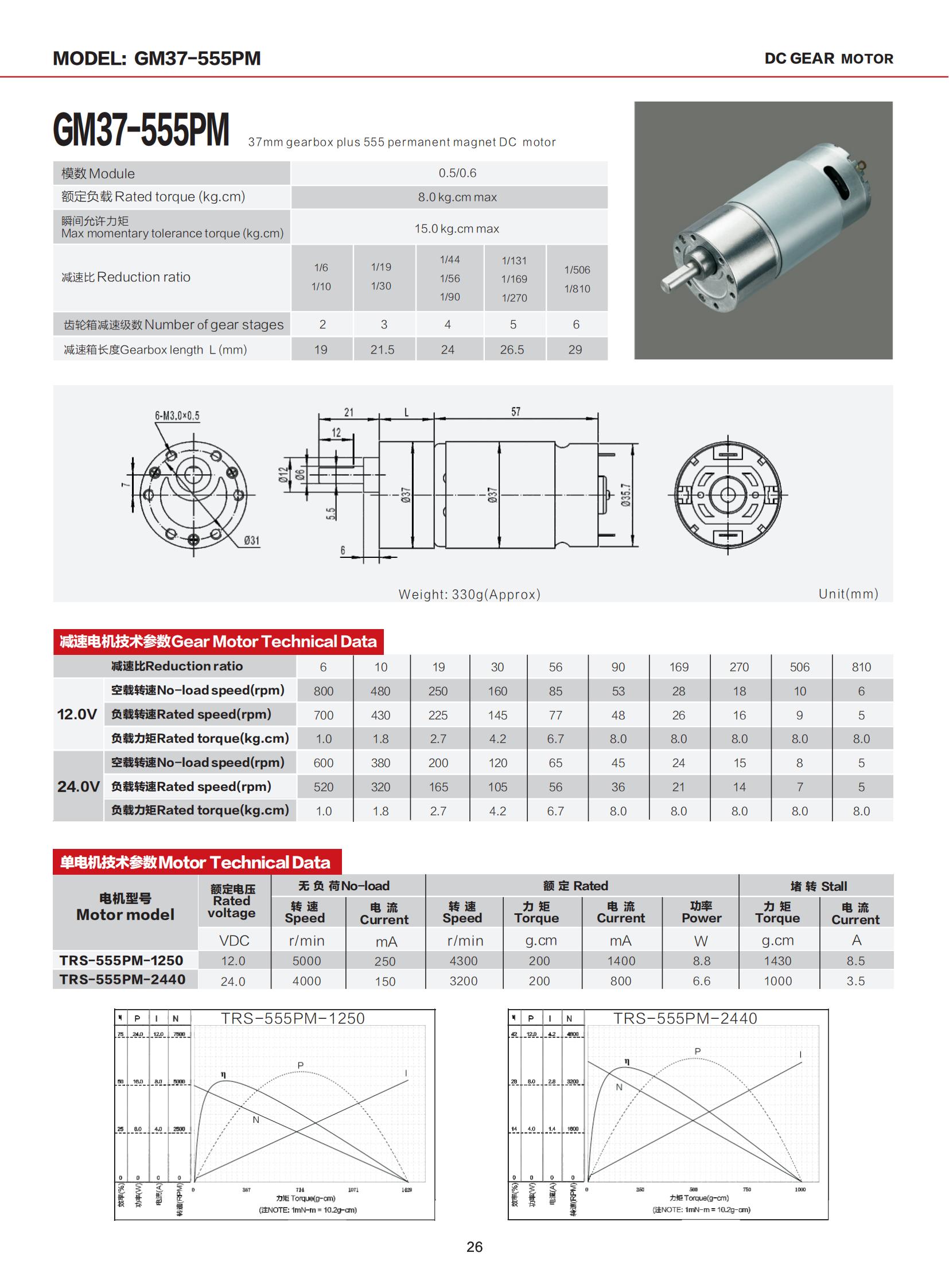
- Motor type: DC brush spur gear motor
- Rated voltage: DC 12 V–24 V
- Speed range: 5–800 rpm
- Maximum rated torque: 8.0 kg.cm
- Gear stages: 2 / 3 / 4 / 5 / 6
- Gearbox length: 19 / 21.5 / 24 / 26.5 / 29 mm
- Module: 0.5 / 0.6
- Materials: stainless steel, iron, copper
Analyzer and automated equipment projects usually need a different trade: stable low-speed output, a simple drive, and a flange pattern that fits an existing chassis. The GM37-555PM answers that with a very wide reduction ratio range — 10 reduction ratios from 1/6 to 1/810, supported by 2 to 6 gear stages — which makes stable output at extremely low speed practical. Cost positioning is explicit: simple drive and low system cost. The compact, lightweight body uses a standard 37 mm outer diameter and 6-M2.5 flange holes, which makes replacement and integration straightforward.
The documented project type is the analyzer bench. The model is applied in urine analyzer and body fluid analyzer projects, and the application scenario is also common in the United States, Canada, Mexico and Australia. It is also used in smart home equipment, automated equipment and automated production lines. Recorded case highlights for this model are fast start-stop response, high torque and durability, and it appears together with the GMP36-TEC3650 in a United States logistics program covering conveyor and sorting mechanism drives at 1,000 units over three years or more, operating stably under frequent start-stop and load changes.
Adjacent option for very small sub-assemblies: when even the GMP12T-TDC1215 envelope is too large, the GM12-N20VA DC spur gear motor offers a maximum rated torque of 0.5 kg.cm across 2, 4, 5 or 7 gear stages, operating at 2.4 V or 5 V with a speed range of 12–1450 rpm and a gearbox length of 9 mm or 12 mm. It is used in smart home drive applications such as smart curtains, smart camera pan-tilt units and smart pet feeders, under low-speed, limited-space conditions with miniaturization, low noise and low power consumption requirements.
Step-by-Step Breakdown: Matching One of These Motors to a Project
- Start from the load and the duty cycle, not the motor. Write down whether the axis runs continuously or intermittently, whether it positions or rotates freely, and whether it must hold position when power is removed. Holding position is the point where the TWG3246-TEC2430 self-locking worm output replaces a brake.
- Set a torque target above the calculated load. Rated torque is the torque that can be continuously output under specified operating conditions — it is not a peak figure. Add margin for friction, acceleration peaks and voltage variation, and check whether the application allows short-term heavy-load impact, which the GMP36-TEC3650 supports with a large safety margin.
- Fix the speed window and derive the reduction ratio. The gear stage count follows from the ratio. The GMP36-TEC3650 covers 10 reduction ratios from 1/4 to 1/720 across 1 to 4 stages; the GM37-555PM covers 10 ratios from 1/6 to 1/810 across 2 to 6 stages.
- Choose the architecture from the duty, not the price list. Brushless planetary (GMP36-TEC3650) for dynamic joints, continuous automation and long unattended duty; brushless worm (TWG3246-TEC2430) for slow, smooth, self-locking positioning; coreless (GMP12T-TDC1215) for micro positioning with fast response and low inertia; brushed spur (GM37-555PM) for analyzers and automated lines where simple drive and low system cost dominate.
- Check the mechanical interface before anything else is ordered. Confirm gearbox length against the available cavity — 14.9–29.3 mm, 19–29 mm, 26–47.5 mm or a fixed 46 mm — then confirm flange holes and shaft. Most integration failures are dimensional, not electrical.
- Match the electrical rail and control. Decide between DC 4.5–12 V and DC 12–24 V, then confirm whether voltage, shaft, encoder, gearbox, logo or speed customization is required. All six customization options are available on an OEM/ODM basis.
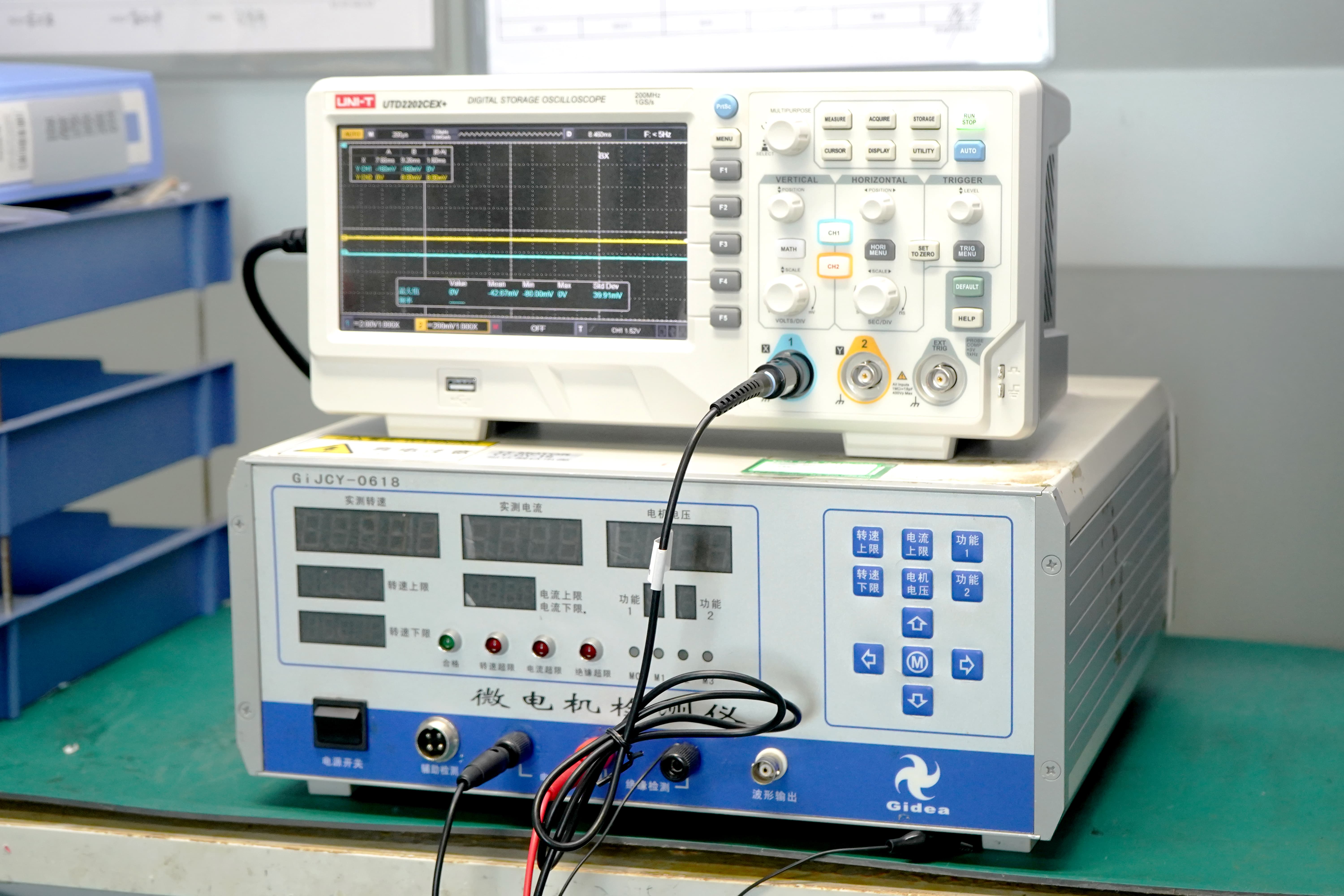
- Validate on a sample before committing to a production order. Sample lead time is 15–25 days and bulk production is 30–45 days, with a minimum order quantity of 2 pieces, so validation on the real duty cycle is realistic. Test at the actual load, speed and duty, and observe positioning overshoot, audible noise, vibration and thermal behaviour at the same time.
Comparison Table: The Four Recommended Gear Motors Side by Side
| Model | Motor type | Rated voltage | Speed range | Max rated torque | Gear stages | Gearbox length (mm) | Documented project profile |
|---|---|---|---|---|---|---|---|
| GMP36-TEC3650 | Brushless planetary gear motor | DC 12–24 V | 4–1600 rpm | 30.0 kg.cm | 1 / 2 / 3 / 4 | 26 / 33.5 / 40.5 / 47.5 | Robot joints, industrial automation, medical pumps, logistics conveying and sorting |
| TWG3246-TEC2430 | DC brushless worm gear motor | DC 12–24 V | 3–35 rpm | 8.0 kg.cm | 3 / 4 / 5 | 46 | Miniature medical devices, precision automated instruments, electrically adjustable supports, smart lock mechanisms |
| GMP12T-TDC1215 | DC brush coreless gear motor | DC 4.5–12 V | 8–5000 rpm | 2 kg.cm | 1 / 2 / 3 / 4 | 14.9 / 19.7 / 24.5 / 29.3 | Precision robots, micro sensors, dental instrument micro positioning, pipetting equipment, robot joint drive modules |
| GM37-555PM | DC brush spur gear motor | DC 12–24 V | 5–800 rpm | 8.0 kg.cm | 2 / 3 / 4 / 5 / 6 | 19 / 21.5 / 24 / 26.5 / 29 | Urine analyzer and body fluid analyzer projects, automated equipment, automated production lines |
Use Cases: Where Each Motor Fits in a Real Build
Robot joints and actuator modules
Robot joint projects need high power density, fast response and low inertia under high-frequency dynamic motion with rapid start and stop. The GMP36-TEC3650 is specified for that profile at DC 12–24 V with 4–1600 rpm and up to 30.0 kg.cm, working with joints, encoders and actuators in start/stop, forward/reverse and speed-change modes. Where the joint module is smaller, the GMP12T-TDC1215 is applied in robot joint type projects as a joint drive, supporting rapid start-stop and bidirectional rotation at adjustable speed up to 2 kg.cm at DC 4.5–12 V.
Low-speed positioning in miniature medical devices
Medical positioning axes typically need very slow, smooth fine adjustment and a mechanism that holds position without adding a brake. The TWG3246-TEC2430 delivers 3–35 rpm with 8.0 kg.cm at DC 12–24 V through right-angle self-locking worm output, with low power consumption, minimal electromagnetic interference and extremely low operating noise. Its documented applications are miniature medical devices, precision automated instruments and electrically adjustable supports, and it appears in a United Kingdom medical pump drive program at 500 to 2,000 units per year running three years or more, where low noise, low vibration and long lifespan were the recorded highlights.
Precision robotics, micro sensors and dental instruments
When the axis is tiny and the tolerance is tight, low rotor inertia becomes the deciding property. The GMP12T-TDC1215 is used in precision robots, micro sensors, medical equipment and high-end consumer electronics, and in pipetting equipment projects alongside urine analyzers and body fluid analyzers. A dental instrument manufacturer in Japan applies it to a micro positioning and adjustment mechanism at 500 to 2,000 units per year over three to five years, and the recorded project result was rapid response with improved equipment control precision.
Analyzers and automated production lines
Analyzer benches and automated lines reward a simple, stable, low-cost drive with a familiar mounting pattern. The GM37-555PM is applied in urine analyzer and body fluid analyzer projects at DC 12–24 V with 5–800 rpm and up to 8.0 kg.cm rated torque, with 10 reduction ratios from 1/6 to 1/810 supporting stable output at extremely low speed and a standard 37 mm outer diameter with 6-M2.5 flange holes for easy replacement. Its recorded case highlights are fast start-stop response, high torque and durability, and it is also common in automated equipment and automated production lines.
FAQ
Do these gear motors have to meet EU or IEC efficiency regulations?
Regulation (EU) 2019/1781 sets minimum efficiency performance standards for motors from 0.12 kW to 1,000 kW — IE2 in the 0.12–0.75 kW band and IE3 from 0.75 kW to 1,000 kW — and the IEC 60034-30-1:2025 update introduced an IE5 ultra-premium efficiency class. Those thresholds define the regulatory band for larger industrial motors. For the 12–24 V and 4.5–12 V gear motors in this shortlist, selection is governed at project level by rated torque, duty cycle, noise, vibration and electromagnetic interference, and buyers should confirm the documentation their own market requires before release. TT Motor runs a 100% test regime on production, and its export markets are the EU, the US and East Asia.
Can the GMP36-TEC3650, TWG3246-TEC2430, GMP12T-TDC1215 and GM37-555PM be customized for a specific project?
Yes. TT Motor works on an OEM/ODM basis with customization available on shaft, encoder, gearbox, voltage, logo and speed. In practice that means the GMP36-TEC3650 can be configured across 1 to 4 gear stages with gearbox lengths of 26/33.5/40.5/47.5 mm and a customized voltage; the GMP12T-TDC1215 offers 1 to 4 stages at 14.9/19.7/24.5/29.3 mm with standard flange mounting for very small devices; the GM37-555PM keeps a standard 37 mm outer diameter with 6-M2.5 flange holes; and the TWG3246-TEC2430 can be matched across 3 to 5 gear stages at a 46 mm gearbox length.
What is the minimum order quantity, and where does cost come from?
The minimum order quantity is 2 pieces, so a project can validate the exact configuration before committing to production volumes. Capacity is not the constraint: the factory produces 800,000 pieces per month against an annual output of 8,000,000 pieces. On cost, the GM37-555PM is designed around a simple drive and low system cost, while the brushless GMP36-TEC3650 and TWG3246-TEC2430 remove brush replacement from the maintenance schedule over long duty cycles. Because gear stage count, encoder and custom shaft or voltage all change the configuration, quote the full duty cycle rather than only the motor model.
Can we test a sample before production?
Yes. Sample lead time is 15–25 days and bulk production is 30–45 days. Rated torque is defined as the torque that can be continuously output under specified operating conditions, so a sample should be tested at your real load, speed and duty cycle — that is where positioning overshoot, noise, vibration and thermal behaviour become visible. Projects such as the Japanese dental instrument micro positioning mechanism and the United Kingdom medical pump drive run at 500 to 2,000 units per year, which shows how a low-volume project can start from a validated sample.
What is the lead time, and how do we start a project?
Samples ship in 15–25 days; bulk orders in 30–45 days; after-sales support is provided remotely. To start, send the drive profile: required torque at the output shaft, target speed, available voltage, the envelope including gearbox length and flange pattern, and the duty cycle. The team can then confirm whether GMP36-TEC3650, TWG3246-TEC2430, GMP12T-TDC1215 or GM37-555PM is the closest starting point, or whether a customized configuration is needed. Contact sales26@ttmotor.com or Sally Su on +86 180-0299-3379 (WhatsApp +(86)18002993379) to begin.
Conclusion: Match the Motor to the Project, Not the Catalogue
The four models in this shortlist are not interchangeable, and that is the point. Robot joints and dynamic automation axes need the high power density, fast response and low inertia of the GMP36-TEC3650 at 30.0 kg.cm and 4–1600 rpm. Miniature medical positioning axes that must hold position without a brake need the self-locking, right-angle worm output of the TWG3246-TEC2430 at 3–35 rpm. Precision robotics and micro sensors need the low rotor inertia and fast response of the GMP12T-TDC1215 at 2 kg.cm in a 14.9–29.3 mm gearbox. Analyzer benches and automated lines need the stable low-speed output and simple drive of the GM37-555PM at 5–800 rpm with a standard 37 mm interface.
All four are built by TT Motor (Shenzhen) Industrial Co., Limited, which supports OEM/ODM customization across shaft, encoder, gearbox, voltage, logo and speed, with a minimum order quantity of 2 pieces, sample lead time of 15–25 days, bulk lead time of 30–45 days and remote after-sales support. Send the torque, speed, voltage and envelope of your project and the closest match — or a customized configuration — can be confirmed from there.
Next Step: Samples, Quotes and the Full Range
Request a sample or a quotation for GMP36-TEC3650, TWG3246-TEC2430, GMP12T-TDC1215 or GM37-555PM. Contact Sally Su at sales26@ttmotor.com or +86 180-0299-3379. You can also download the company brochure with the full miniature motor range here: TT Motor product brochure (PDF).
Have Questions or Need More Details?
Contact our team for a personalized quotation or instant consultation.
Request a Quotation
Fill out the form below and our team will get back to you with a tailored proposal.
WhatsApp Direct Chat
Prefer to chat in real-time? Message us on WhatsApp for instant assistance & quick answers.
- Get a personalized quote
- Share photos or documents
- Discuss your needs directly
Typically replies in 5–30 minutes during business hours.