
Brushless Motor Duty Cycle Selection: Continuous vs Intermittent Operation Guide
Duty cycle — the relationship between powered time and rest time inside one operating cycle — usually eliminates a gear motor from a design long before peak torque does. A miniature motor that holds torque beautifully on a bench can still wear out early in the field if the application keeps it energised far longer than its construction was built for. The practical question is therefore not only “how much torque does it produce” but “how long, and how often, must it produce that torque?”
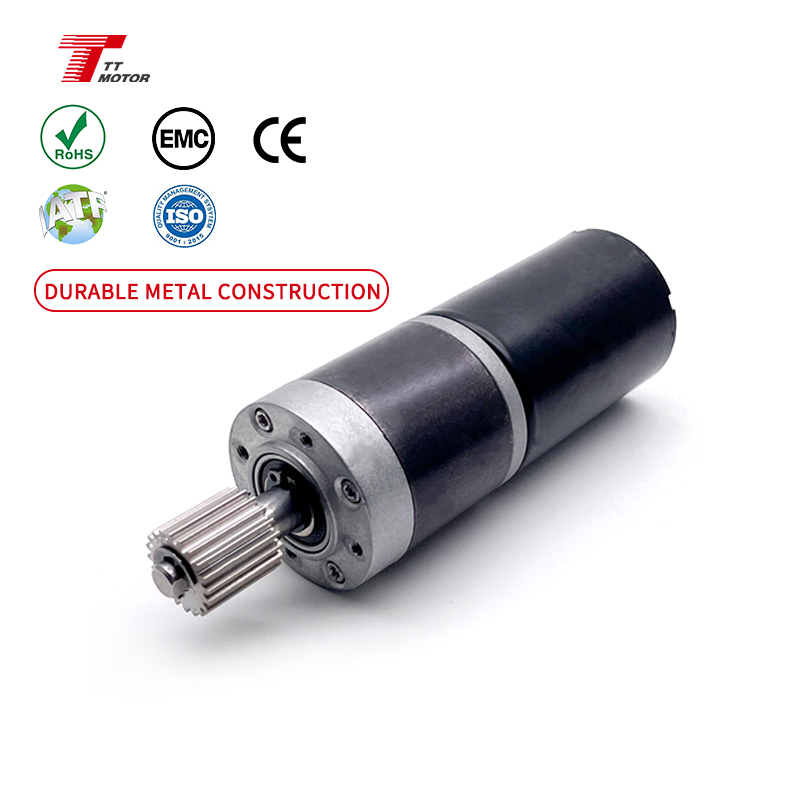
This guide explains how to match brushless motor construction to duty cycle. Two TT Motor brushless gear motors are used as reference points: the TWG3246-TEC2430 brushless worm gear motor, built around low-speed intermittent positioning between 3 rpm and 35 rpm, and the GMP36-TEC3650 brushless planetary gear motor, applied where long-term operation and frequent start-stop cycles are the dominant requirement. Where continuous operation is the deciding factor, the brushed GM37-555PM spur gear motor is included as an honest contrast point, because brushed DC gear motors still hold commercial advantages in some duty profiles.
About the manufacturer referenced in this guide: TT Motor (Shenzhen) Industrial Co., Limited is a miniature DC motor manufacturer established in 2006, headquartered in Bao’an District, Shenzhen, Guangdong Province, with a manufacturing area of approximately 9,000 m², over 300 employees, and an annual output of 8,000,000 pieces. Its main products include brushless motors, coreless motors, gear motors, stepper motors and DC motors, and approximately 70% of output is exported to EU and USA markets.
What Duty Cycle Means in Brushless Gear Motor Selection
Duty cycle describes how a motor is energised over time. Continuous duty means the motor runs without a defined rest period. Intermittent duty means powered periods alternate with defined unpowered or rest periods. Motor documentation commonly labels these duty types with standard designations so that a buyer, an engineer and a supplier are describing the same load profile.
The reason this matters for miniature geared motors is that the duty profile changes which failure mechanism arrives first:
- Under continuous duty, the dominant limits are thermal behaviour and, in brushed motors, mechanical wear at the brush and commutator interface.
- Under intermittent positioning duty, the dominant requirements become holding behaviour at standstill, repeatability of very small movements, and the ability to stop precisely without drift.
For a brushless DC gear motor, the selection therefore reduces to four decisions: commutation type, which determines wear and spark behaviour; gearbox architecture, which determines self-locking and backlash; gear stage count, which determines the speed–torque trade-off; and rated voltage, which determines drive compatibility. Each of these is a constraint that can be verified against a datasheet before a sample is ever ordered.
Why Brushless Construction Changes the Duty Cycle Question
A brushless motor uses electronic commutation instead of carbon brushes. Because there is no brush contacting a commutator, the physical wear mechanism that exists in brushed DC motors of comparable size is removed. This is the single most important structural difference when duty cycle is under discussion, because brush wear scales with running hours rather than with load alone.
For the TWG3246-TEC2430 brushless worm gear motor, this is documented directly: the product uses brushless motor construction with electronic commutation instead of carbon brushes, and because of the brushless structure it does not generate sparks during operation. It is designed for minimal electromagnetic interference during operation, low operating noise, and a wear-resistant, impact-resistant mechanical structure.
Market context supports why this design question has moved to the centre of miniature drive selection. The global brushless DC (BLDC) motor market was valued at between USD 22.2 billion and USD 22.33 billion in 2025 according to Grand View Research and Precedence Research. Separately, global trade in electric motors with an output below 37.5 W — the HS 850110 product category that covers small DC motors — reached USD 16.3 billion in 2024 according to OEC trade data. Small motors are a mature, high-volume category, which means the practical differentiator between suppliers is not availability but how precisely a motor is matched to its load profile.
One boundary worth stating clearly for procurement teams: the EU Ecodesign Regulation (EU) 2019/1781 sets minimum efficiency performance standards of IE3 for motors in the 0.75 kW to 1000 kW range, with IE2 applying from 0.12 kW to 0.75 kW. The IEC 60034-30-1:2025 update introduces the IE5 ultra-premium efficiency class for the same regulated scope. Miniature gear motors sit well below that power band, so duty-cycle selection for a motor such as the GMP36-TEC3650 is driven by application requirements and documentation rather than by IE class compliance. This is a constraint worth knowing before a specification document is written, because it prevents an irrelevant efficiency requirement from being placed on a micro-motor supplier.
The Core Selection Parameters: Voltage, Torque, Speed and Gear Stages
Four parameters carry almost all of the duty-cycle decision. They should be read together, because changing one always changes the others.
Rated voltage sets drive compatibility. A motor specified for DC 12 V to 24 V can be verified against both a 12 V rail and a 24 V rail. The TWG3246-TEC2430 and the GMP36-TEC3650 both fall in this range, and a 12 V supply sits within the specified DC 12 V to 24 V rated voltage range of both products.
Rated torque is defined as the torque that can be continuously output under specified operating conditions. That definition matters for duty-cycle work: a maximum rated torque figure describes the gearbox output capability under the specified conditions, and it should not be treated as an unlimited peak that can be held indefinitely without checking the operating profile.
Output speed determines whether a gearbox architecture is even relevant. A worm gear motor rated for 3–35 rpm and a planetary gear motor rated for 4–1600 rpm are not interchangeable, even when their voltage and torque envelopes appear similar.
Number of gear stages determines the reduction ratio and therefore the trade-off between output speed and available torque. It also determines the physical gearbox length, which is a hard constraint inside a compact enclosure.
Intermittent Positioning: TWG3246-TEC2430 Brushless Worm Gear Motor
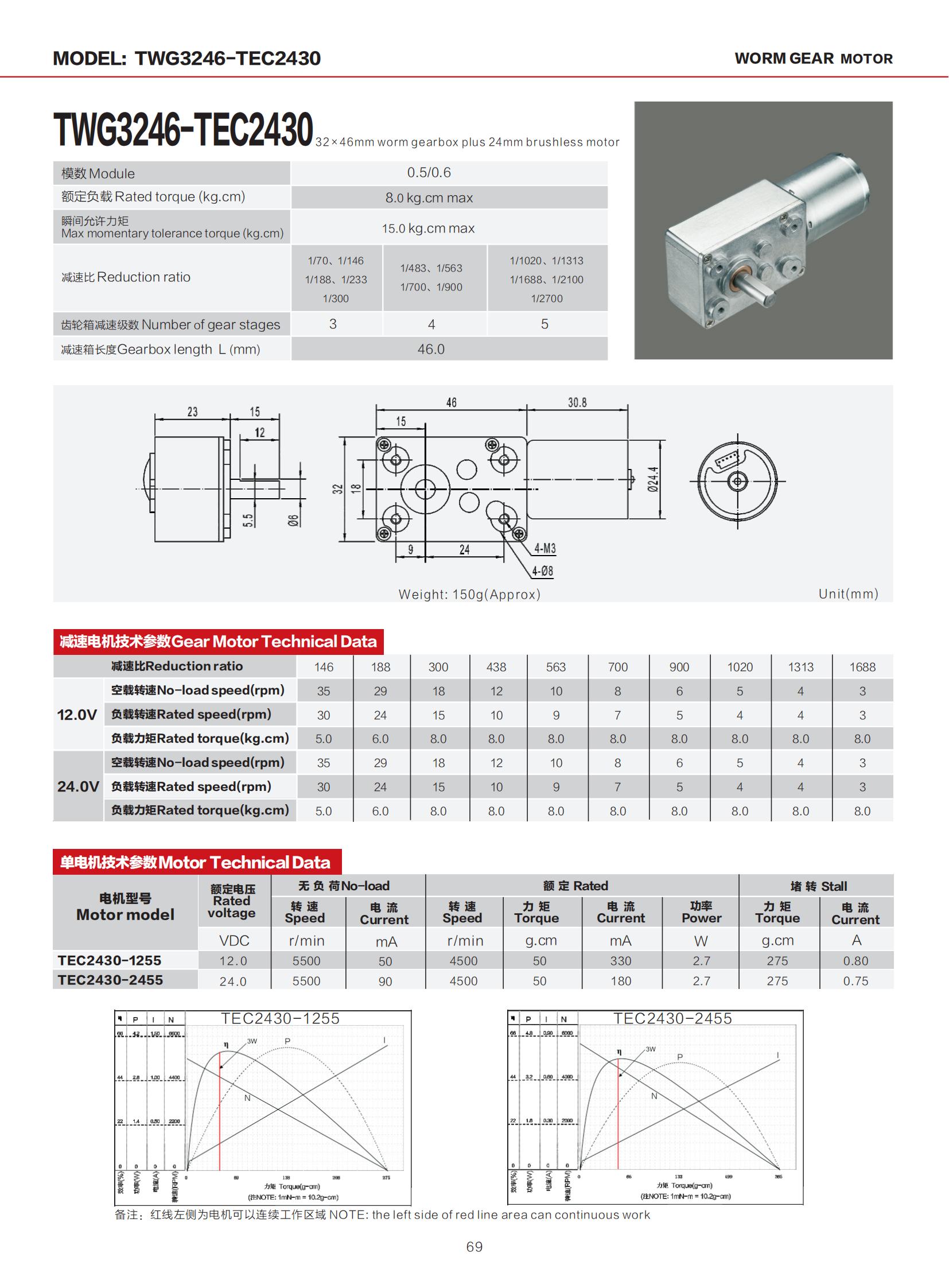
The TWG3246-TEC2430 is a DC brushless worm gear motor rated at DC 12 V to 24 V, with an output speed range of 3 rpm to 35 rpm and a maximum rated torque of 8.0 kg.cm at the gearbox output. The gearbox length is 46 mm, which defines the mounting envelope, and the gearbox is available with 3, 4 or 5 gear stages. The gear module is 0.5 or 0.6. Primary materials are stainless steel, iron and copper.
Its structural configuration is a right-angle output worm gearbox with a self-locking function. Because of that self-locking worm gearbox, no additional braking device is required. This is the detail that makes the motor a natural fit for intermittent positioning duty: in an application such as an electrically adjustable support, a smart curtain drive or a low-speed positioning mechanism, the load has to hold its position between moves. A self-locking gearbox removes the need for a separate holding brake, the control logic that drives it, and the power draw it would require during the rest portion of the cycle.
The duty profile is documented as low-speed, intermittent, positioning operation, and the product is designed for miniature medical devices, precision automated instruments and electrically adjustable supports. For a buyer comparing motors purely on torque, this specification is easy to miss — an 8.0 kg.cm worm gear motor and an 8.0 kg.cm spur gear motor can carry the same headline number while serving completely different duty cycles.
Continuous and Frequent Start-Stop Duty: GMP36-TEC3650 Brushless Planetary Gear Motor
Where the application keeps running, or starts and stops constantly, the planetary layout is the more appropriate architecture. The GMP36-TEC3650 brushless planetary gear motor is rated DC 12 V to 24 V, with a speed range of 4 rpm to 1600 rpm, a maximum rated torque of 30.0 kg.cm, and a reduction ratio range from 1/4 to 1/720 achieved with 1 to 4 gear stages. Gearbox length variants of 26 mm, 33.5 mm, 40.5 mm and 47.5 mm correspond to the number of gear stages, with the motor and gearbox sharing a 36 mm diameter and a total weight of 420 g.
Its brushless design removes the brush and commutator wear mechanism that exists in brushed DC motors of comparable size. That is the core duty-cycle argument for the planetary brushless motor: continuous operation and frequent start-stop cycling both spend running hours, and running hours are what consume brushes. The product is specified for low noise, achieved through a precision-machined planetary gear set, and the planetary gearbox is specified with minimal transmission backlash, which is directly relevant to positioning accuracy checks.
The mechanical interface is defined by an 8 mm solid output shaft and four M3 flange holes. Those dimensions, together with the 26 mm to 47.5 mm gearbox length range and the 420 g weight, are the numbers a mechanical designer needs in order to confirm that the motor fits the available space before requesting a sample.
The associated duty profiles reinforce the architectural logic. Brushless motors of this type are used in robot joints operating under high-frequency dynamic motion with rapid start and stop, in medical equipment requiring low-speed precision motion with long-term operation and low noise and vibration, and in logistics equipment driving conveyors and sorting mechanisms where stable operation under frequent start-stop and load changes is required over three years or more.
When a Brushed DC Gear Motor Still Makes Sense: GM37-555PM
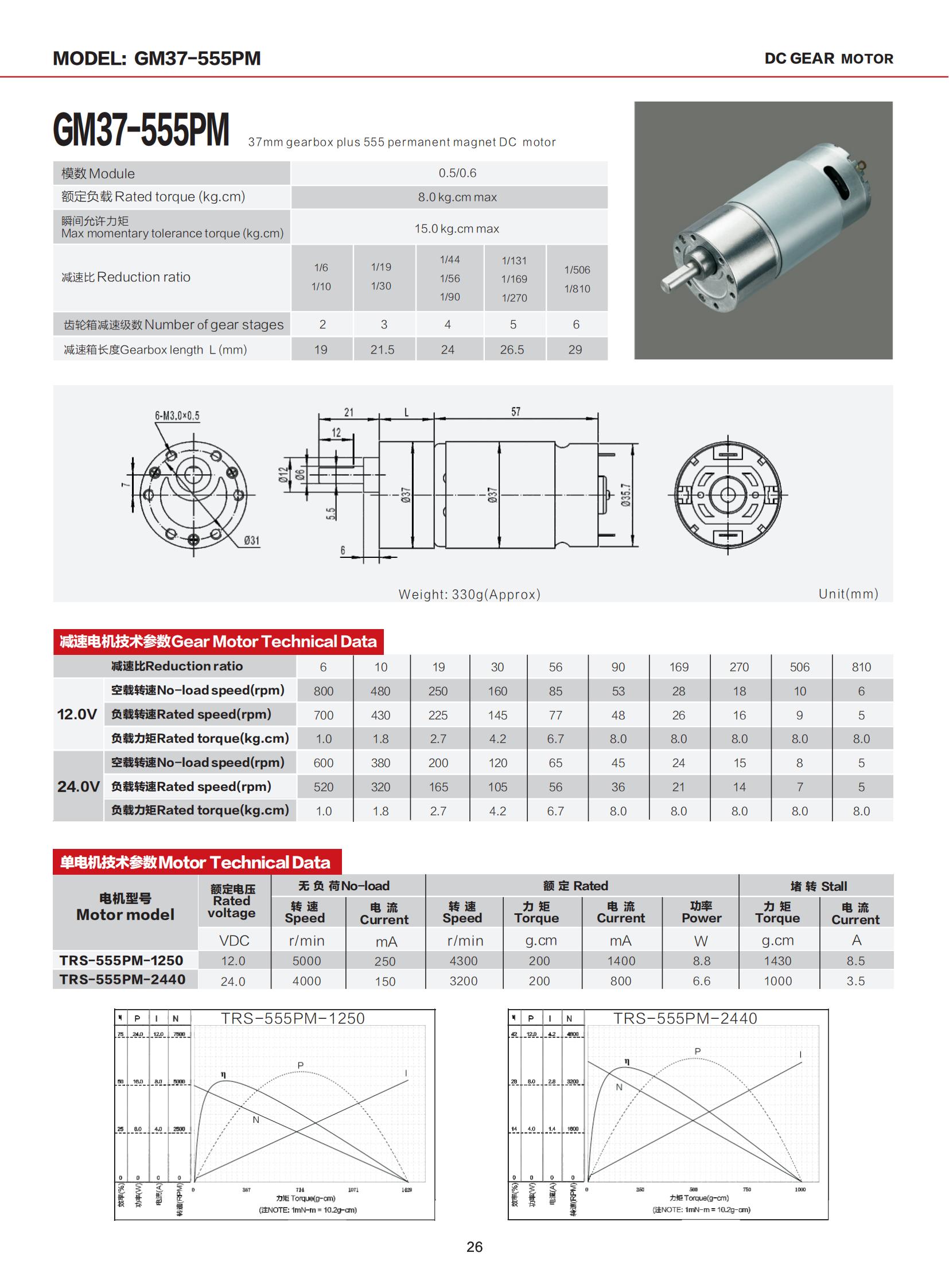
Brushless is not automatically the correct answer. The GM37-555PM is a DC brush spur gear motor rated DC 12 V to 24 V, with an output speed range of 5 rpm to 800 rpm and a maximum rated torque of 8.0 kg.cm. Ten reduction ratios from 1/6 to 1/810 are available, and the motor supports 2 to 6 gearbox stages to achieve stable output at speeds as low as 5 rpm. It has a standard 37 mm outer diameter and 6-M2.5 flange holes, which makes replacement and integration straightforward in equipment with an existing 37 mm mounting pattern.
Its documented advantages are cost-related: high cost-effectiveness from a simple drive and low system cost, plus a compact and lightweight design. For a duty profile with genuinely limited running hours — a few short moves per day in a smart home appliance or a low-duty automated production line function — a brushed spur gear motor can deliver the required torque at a lower system cost, because it does not require the electronic commutation drive that a brushless motor needs.
The trade-off should be stated plainly. A brushed motor has a brush and commutator contact surface that wears with running hours, and brush replacement is a maintenance event. Where the application runs continuously, or cycles frequently over years, that wear mechanism becomes the limiting factor on service life rather than the gearbox or the bearings. This is the decision rule, not a product ranking: low running hours favour brushed on cost; high running hours and frequent cycling favour brushless on service life and maintenance.
Step-by-Step: Matching Motor Construction to Your Duty Cycle
- Define the duty profile before opening a datasheet. Write down the powered time and the rest time within one cycle, and how many cycles occur per day. Intermittent positioning, frequent start-stop and continuous running lead to different motor families.
- Confirm the load must be held at standstill. If the mechanism has to hold position between moves, a self-locking worm gearbox removes the need for an additional braking device. If the mechanism is continuously driven and position holding is not required, that constraint disappears.
- Fix the output speed window. A positioner running between 3 rpm and 35 rpm and a conveyor drive running between 4 rpm and 1600 rpm sit at opposite ends of the miniature gear motor range. Speed selection eliminates most candidates immediately.
- Confirm rated torque at the gearbox output against the real load. Use the maximum rated torque figure together with the actual operating profile, not the stall condition.
- Choose the gear stage count and check the resulting length. On the GMP36-TEC3650, moving from 1 to 4 gear stages changes the gearbox length from 26 mm to 47.5 mm. On the GM37-555PM, the gearbox length varies between 19 mm and 29 mm across 2 to 6 stages.
- Verify voltage and drive compatibility. DC 12 V to 24 V covers both common industrial rails. If the application only has a 12 V rail, confirm it sits inside the specified range.
- Confirm documentation before design freeze. RoHS, REACH, CE and ISO 9001 documentation should be matched to the exact model number, not to a generic product family.
Use Cases by Duty Profile
| Duty profile | Typical application | Gearbox architecture to prioritise |
|---|---|---|
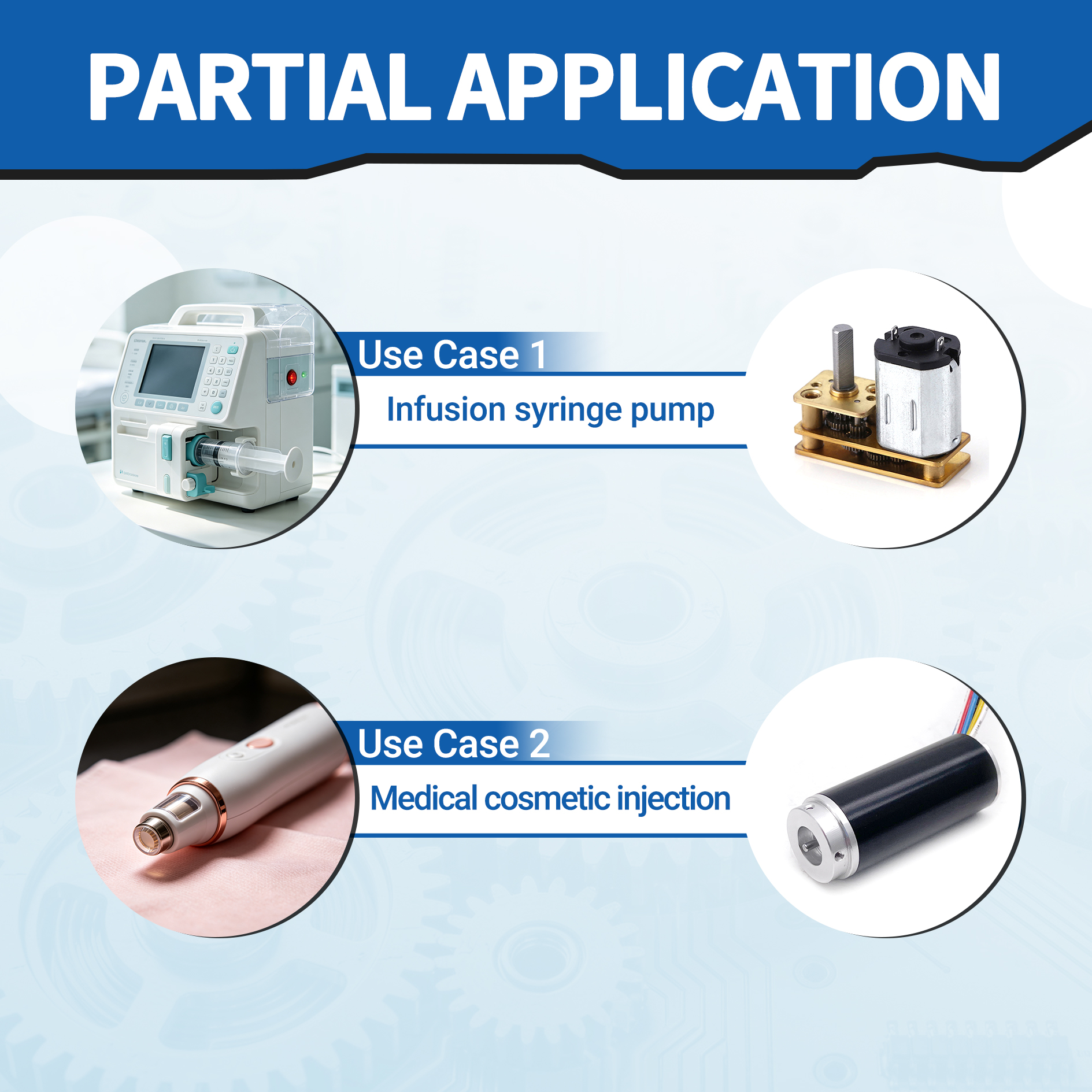
| Low-speed intermittent positioning | Electrically adjustable supports, smart curtains, miniature medical devices, precision automated instruments | Self-locking worm gearbox, no additional braking device required |
| Frequent start-stop and load change | Logistics conveyors and sorting mechanisms | Brushless planetary, high torque with rapid start-stop response |
| High-frequency dynamic motion | Robot joints and precision actuators | Brushless planetary, minimal transmission backlash |
| Long-term operation with low noise | Medical pumps and precision delivery mechanisms | Brushless or coreless construction, low vibration output |
| Low running hours per day, cost-sensitive | Smart home appliances, low-duty automated equipment functions | Brushed spur gearbox with simple drive and low system cost |
Side-by-Side Comparison
The table below compares the three reference motors on the parameters that actually constrain a duty-cycle decision. All values are taken from published product specifications.
| Parameter | TWG3246-TEC2430 | GMP36-TEC3650 | GM37-555PM |
|---|---|---|---|
| Motor type | DC brushless worm gear motor | Brushless planetary gear motor | DC brush spur gear motor |
| Commutation | Electronic, no carbon brushes, no sparks during operation | Electronic, brush and commutator wear mechanism removed | Brushed |
| Rated voltage | DC 12 V – 24 V | DC 12 V – 24 V | DC 12 V – 24 V |
| Maximum rated torque | 8.0 kg.cm | 30.0 kg.cm | 8.0 kg.cm |
| Output speed range | 3 – 35 rpm | 4 – 1600 rpm | 5 – 800 rpm |
| Gear stages | 3 / 4 / 5 | 1 / 2 / 3 / 4 | 2 / 3 / 4 / 5 / 6 |
| Gearbox length | 46 mm | 26 / 33.5 / 40.5 / 47.5 mm | 19 / 21.5 / 24 / 26.5 / 29 mm |
| Gear module | 0.5 / 0.6 | 0.5 | 0.5 / 0.6 |
| Self-locking | Yes, no additional braking device required | Not specified | Not specified |
| Materials | Stainless steel, iron, copper | Stainless steel, copper, iron | Stainless steel, iron, copper |
| RoHS certification (SGS) | CANEC26013326101 | CANEC26013325501 | CANEC26013323201 |
| Typical duty association | Low-speed, intermittent positioning operation | Long-term operation, frequent start-stop and load changes | Smart home and automated equipment, cost-sensitive duty |
Compliance and Documentation for Duty-Critical Builds
Duty cycle and documentation are linked in procurement, because a motor specified for long-term operation is a motor whose compliance evidence will be audited. The following documentation is published for the product models discussed in this guide.
Quality management system: TT Motor (Shenzhen) Industrial Co., Limited is certified to ISO9001:2015 under certification number F02926Q00865R402, issued by DCI to the standard GB/T 19001-2016 / ISO9001:2015. The certification is valid from 2026-08-21 to 2029-08-21 and applies to the global market. Its scope covers R&D and manufacture of micromotors (DC gear motor, DC brushless motor), with 3C excluded, and it applies to the DC Gear Motor GM12-N20VA, Brushless Motor GMP36-TEC3650, DC Gear Motor GM37-555PM, Coreless Motor GMP12T-TDC1215 and Worm Gear Motor TWG3246-TEC2430.
RoHS compliance for the EU market is documented model by model:
- TWG3246-TEC2430 — SGS certificate CANEC26013326101, issued 2026-06-24, valid through 2099-01-01, referencing RoHS Directive (EU) 2015/863 amending 2011/65/EU, covering DC gear motors including the TWG3246-TEC2430 and related series models.
- GMP36-TEC3650 — SGS certificate CANEC26013325501, issued 2026-04-10, valid until 2099-01-01, covering the GMP36-TEC3650 and related series models.
- GM37-555PM — SGS certificate CANEC26013323201 under RoHS Directive (EU) 2015/863, covering the GM37-555PM and related series models.
- GM12-N20VA and GM24-N20VA — SGS certificate CANEC26005990201, tested to the IEC 62321 series standards.
CE certification is documented for the GM12-N20VA DC gear motor under certificate number CTL2512182011-EC, issued by CTL for the EU market on 2025-12-25. The motor complies with EN IEC 61000-6-3:2021 for electromagnetic emissions and EN IEC 61000-6-1:2019 for electromagnetic immunity. This is directly relevant to duty-cycle selection in one specific way: brushless commutation is chosen partly for electromagnetic behaviour, and having EMC test evidence available shortens the compliance work required on the final assembly.
REACH compliance is documented for the GM12-N20VA DC gear motor under EU REACH Regulation (EC) No 1907/2006. The SGS test report number is SZXEC25000315601, issued 2025-02-20 and valid until 2099-01-01, covering SVHC candidate-list substance screening for the GM12-N20VA and multiple DC gear-motor models of the same series. The documentation is applicable as incoming material documentation.
Procurement note: when a specification calls for CE, RoHS and REACH documentation, request the certificate for the exact model number being designed in. Certificates are issued per model or per series, and a certificate that covers a different model in the same family does not automatically transfer.
Frequently Asked Questions
Do the TWG3246-TEC2430 and GMP36-TEC3650 come with CE and RoHS documentation for the EU market?
Both models have RoHS documentation for the EU market. The TWG3246-TEC2430 is covered by SGS certificate CANEC26013326101 under RoHS Directive (EU) 2015/863, and the GMP36-TEC3650 is covered by SGS certificate CANEC26013325501 under the same directive. CE certification is currently documented for the GM12-N20VA DC gear motor under certificate CTL2512182011-EC, issued by CTL and tested to EN IEC 61000-6-3:2021 for emissions and EN IEC 61000-6-1:2019 for immunity. Buyers who require CE documentation for a specific brushless model should confirm the applicable certificate against the exact model number before design freeze.
Can a brushless planetary gear motor run continuously, or is it limited to intermittent duty?
Brushless construction removes the brush and commutator wear mechanism that limits the service life of a brushed motor of comparable size, which is why brushless motors are specified for long-term operation and frequent start-stop duty. The GMP36-TEC3650 is associated with applications requiring stable operation under frequent start-stop and load changes over three years or more, and with low-speed precision motion under long-term operation. Continuous duty is still a torque and thermal question, not only a wear question: the maximum rated torque of 30.0 kg.cm is specified under defined operating conditions, and the actual load profile should be compared against it with margin. The distinction to hold on to is that in a brushless motor, running hours do not consume a brush, whereas in a brushed motor they do.
What drives the cost difference between a brushless gear motor and a brushed DC gear motor?
The main driver is the drive architecture. A brushless motor requires electronic commutation, while a brushed motor uses direct brush contact and therefore a simpler drive. The GM37-555PM is documented with high cost-effectiveness from a simple drive and low system cost, with an output speed range of 5 rpm to 800 rpm and a maximum rated torque of 8.0 kg.cm. The comparison should be made on total system cost over the intended duty profile rather than on unit price alone: a brushed motor used in a continuous or frequently cycled application introduces brush replacement as a maintenance event over the life of the equipment, while a brushless motor removes that wear mechanism. The correct choice depends on how many running hours the application actually accumulates.
Can I get samples of these brushless gear motors before committing to a production order?
Yes. The published minimum order quantity for these miniature DC motors is 2 pieces, and the production model supports OEM and ODM work with customization available on shaft, encoder, gearbox, voltage, logo and speed. Sampling is the correct way to validate a duty-cycle assumption, because the parameters that decide the outcome — gear stage count, gearbox length, self-locking behaviour and backlash — are easiest to confirm on a physical unit inside the actual mechanism. To request a sample, contact the sales team at sales26@ttmotor.com or through WhatsApp at +86 180-0299-3379 with the model number, required voltage, target output speed and the duty profile of the application.
What are the lead times for samples and for bulk orders?
Published lead times are 15 to 25 days for samples and 30 to 45 days for bulk orders. Monthly production capacity is 800,000 pieces, three production plants and a professional assembly centre support the manufacturing process, and quality control is specified as 100% test. For projects where a duty-cycle decision has already been made and the requirement is a supply schedule rather than a technical evaluation, the bulk lead time is the relevant planning figure. Full product documentation and the company brochure are available for download from the link at the end of this guide.
Conclusion
Duty cycle is a construction question before it is a performance question. A self-locking worm gearbox such as the one in the TWG3246-TEC2430 solves an intermittent positioning problem by holding the load without an additional braking device, at 3 to 35 rpm and up to 8.0 kg.cm. A brushless planetary gearbox such as the one in the GMP36-TEC3650 solves a running-hours problem by removing the brush and commutator wear mechanism, with 30.0 kg.cm of maximum rated torque, 4 to 1600 rpm, and 1 to 4 gear stages producing gearbox lengths from 26 mm to 47.5 mm. And where running hours are genuinely low, a brushed spur gear motor such as the GM37-555PM remains a defensible choice on system cost at 5 to 800 rpm and 8.0 kg.cm.
The deciding inputs are few and all measurable: how long the motor runs per cycle, whether the load must be held between moves, the output speed window, the torque at the gearbox output, the available mounting length, and the documentation the final assembly has to carry. Confirming those six points against a datasheet prevents the most expensive mistake in miniature drive selection, which is choosing a motor that is strong enough but not built for the duty.

Next step: validate the duty cycle on a physical sample.
TT Motor (Shenzhen) Industrial Co., Limited supplies the TWG3246-TEC2430, GMP36-TEC3650 and GM37-555PM with a published MOQ of 2 pieces, 100% test quality control, and customization available on shaft, encoder, gearbox, voltage, logo and speed.
Website: www.ttmotor.com
Email: sales26@ttmotor.com | WhatsApp: +86 180-0299-3379
Address: 4th Floor, C Building, Huilongda Industrial Park, Shilong Community, Shiyan, Bao’an District, Shenzhen, China
Download the TT Motor product brochure (PDF)
Have Questions or Need More Details?
Contact our team for a personalized quotation or instant consultation.
Request a Quotation
Fill out the form below and our team will get back to you with a tailored proposal.
WhatsApp Direct Chat
Prefer to chat in real-time? Message us on WhatsApp for instant assistance & quick answers.
- Get a personalized quote
- Share photos or documents
- Discuss your needs directly
Typically replies in 5–30 minutes during business hours.