
How to Verify CE and RoHS Documents on China BLDC Motors
A supplier can describe a DC brushless motor as CE and RoHS compliant in an email and still fail your incoming documentation check, because compliance is not a property of a supplier. It is a property of a specific model, tested by a named laboratory, against a named directive, on a recorded date, with a scope statement that either includes your part number or does not.
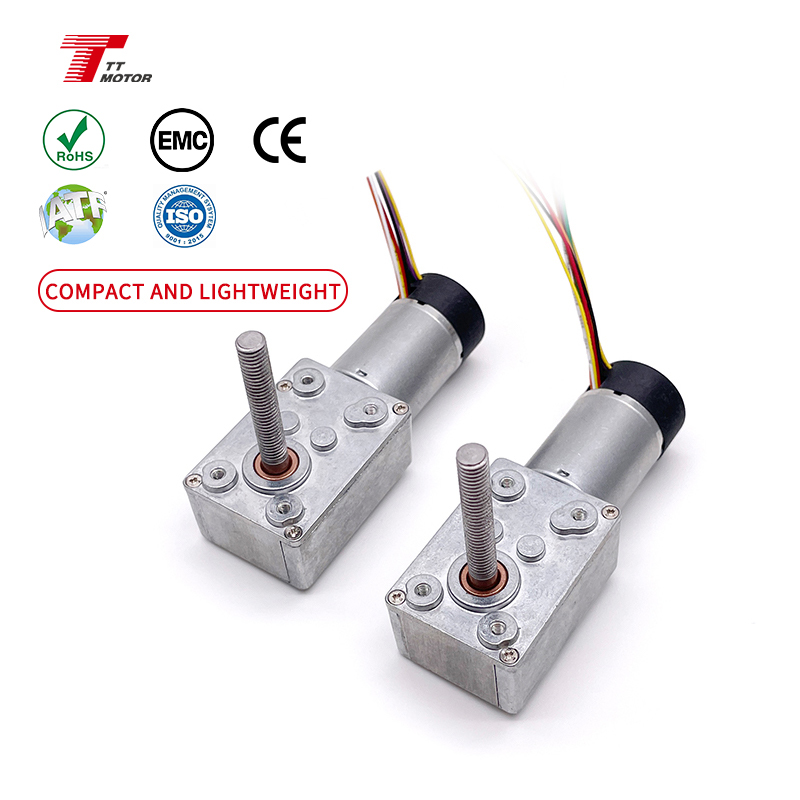
This guide is written for buyers in the research and evaluation stage who are sourcing miniature motors from China: brushless DC motors, coreless motors, and spur, planetary and worm gear motors in the 12 V and 24 V class. It sets out what an auditable document package contains, how to check it against the exact SKU you intend to order, and which parameter constraints must be fixed before any certificate can be issued at all. The published documentation of TT Motor (Shenzhen) Industrial Co., Limited is used as a worked example, because its certificate numbers, standards, issuing bodies and model scopes are specific enough to verify independently.
Why CE and RoHS Compliant Is Not a Verifiable Answer
Most documentation failures in miniature motor sourcing are not forgeries. They are scope mismatches, and they follow three recurring patterns.
- Model mismatch. The report is genuine, but it covers a sibling model or an earlier revision. A certificate that names GM12-N10VA does not automatically cover the GM12-N20VA you ordered unless the scope statement names it.
- Directive mismatch. CE is not a single certificate. For a low-voltage DC gear motor supplied as a component, the relevant CE evidence is normally electromagnetic compatibility evidence against the applicable EN IEC 61000 series standards, not machinery safety or motor efficiency class.
- Scope and date mismatch. Reports reference different editions of a standard, and a document issued several years ago may no longer describe the current production process.
Buyers also misread the boundary in the opposite direction. EU minimum efficiency performance standards, as set in Ecodesign Regulation (EU) 2019/1781, apply to motors from 0.12 kW to 1000 kW, with IE3 required between 0.75 kW and 1000 kW. IEC 60034-30-1:2025 introduced the IE5 Ultra Premium Efficiency class in that same power class. Miniature 12 V and 24 V gear motors sit far below that range, so motor efficiency class is not the governing requirement at this size. The compliance weight falls on RoHS, REACH SVHC screening and EMC instead.
The final risk has nothing to do with paperwork. A compliant sample does not guarantee a compliant batch. The documented failure mode, samples qualified but batch performance inconsistent, is triggered by substituting raw materials or components after sampling, failing to lock the sample process before mass production, sampling in quantities too small to expose batch variation, and changing production equipment or tooling without notification. A supplier that defines acceptance standards before mass production, runs a small-batch trial first, and notifies customers in advance of material or process changes removes most of that risk.
The Supply Base Behind the Paperwork
Category-level data explains why documentation quality varies so widely between suppliers. Grand View Research and Precedence Research both place the global brushless DC motor market at approximately USD 22.2 billion to USD 22.33 billion for 2025, according to the Grand View Research report Brushless DC Motor Market Size, Share Report, 2026-2033. In the smaller-motor segment, OEC trade data records USD 16.3 billion in global exports of electric motors with an output below 37.5 W in 2024 under HS code 850110, the classification that miniature DC motors fall into.
Two conclusions follow for evaluation work. First, the supply base is broad, so a buyer shortlisting suppliers will receive genuinely different document packages, and the differences are usually structural rather than cosmetic. Second, aggregate trade codes cannot isolate a specific form factor: HS 850110 does not separate an N20-class gear motor from other small DC motors, and no public dataset resolves that gap. Model-level certificates therefore remain the only reliable part-number evidence available to a buyer.
That is the practical argument for running compliance checks before price negotiation in industrial, medical and robotics projects. Once a supplier has demonstrated that it can name the issuer, the certificate number, the referenced directive and the covered models, the remaining commercial questions around customization, minimum order quantity and lead time can be settled with far less risk on both sides.
What a Verifiable Document Set Contains
A complete package for a miniature brushless or geared motor has four layers: a quality management system certificate covering the manufacturing activity itself, a RoHS compliance test per model family, a REACH SVHC screening report, and EMC evidence supporting CE where the product is placed on the EU market. The table below shows how those four layers are documented for the miniature motor range manufactured by TT Motor (Shenzhen) Industrial Co., Limited.
| Document | Standard or directive | Issuer | Certificate number | Covered scope |
|---|---|---|---|---|
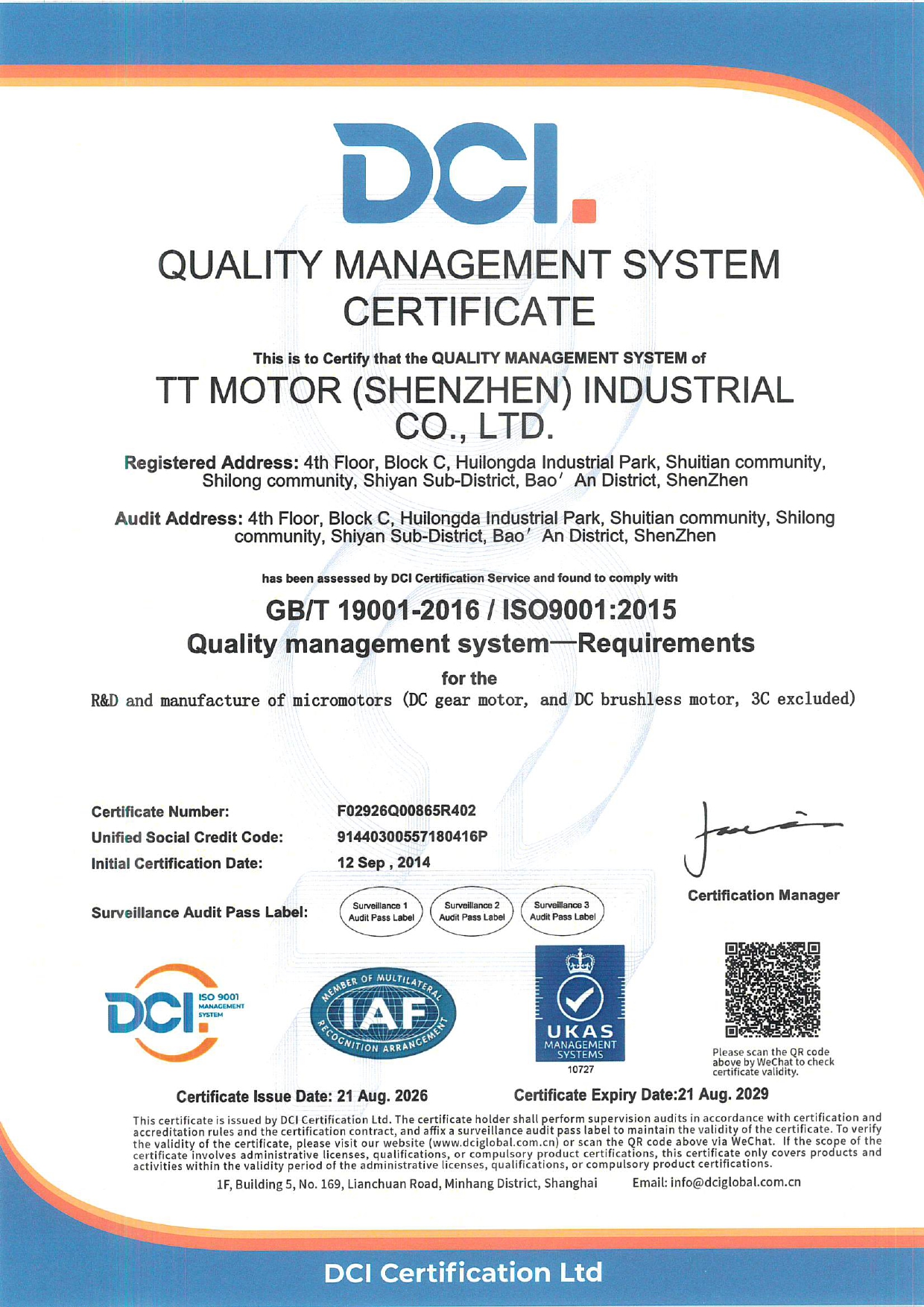
| ISO 9001:2015 | GB/T 19001-2016 / ISO 9001:2015 | DCI | F02926Q00865R402 | R&D and manufacture of micromotors (DC gear motor, DC brushless motor), 3C excluded; valid 2026-08-21 to 2029-08-21; global market |
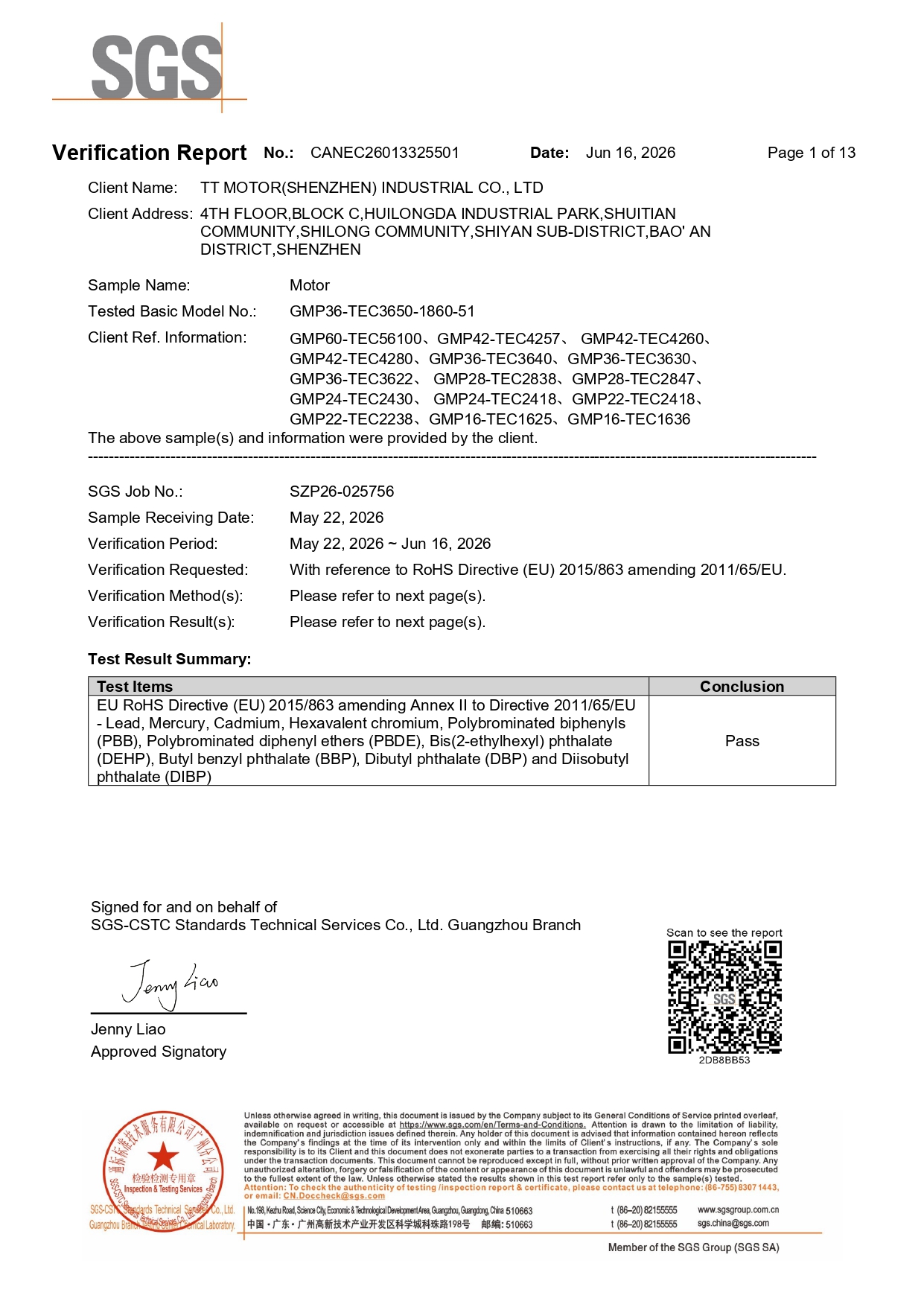
| RoHS | RoHS Directive (EU) 2015/863 amending 2011/65/EU | SGS | CANEC26013325501 | GMP36-TEC3650 brushless planetary gear motor and related series models; issued 2026-04-10 |
| RoHS | RoHS Directive (EU) 2015/863 amending 2011/65/EU | SGS | CANEC26013326101 | TWG3246-TEC2430 DC brushless worm gear motor and related series models; issued 2026-06-24 |
| RoHS | RoHS Directive (EU) 2015/863 amending 2011/65/EU | SGS | CANEC26013325001 | GMP12T-TDC1215 DC coreless motor and related series models |
| RoHS | RoHS Directive (EU) 2015/863; IEC 62321 series test standards | SGS | CANEC26005990201 | GM12-N20VA and GM24-N20VA DC gear motors and related series models |
| RoHS | RoHS Directive (EU) 2015/863 | SGS | CANEC26013323201 | GM37-555PM DC gear motor and related series models; issued 2026-07-03 |
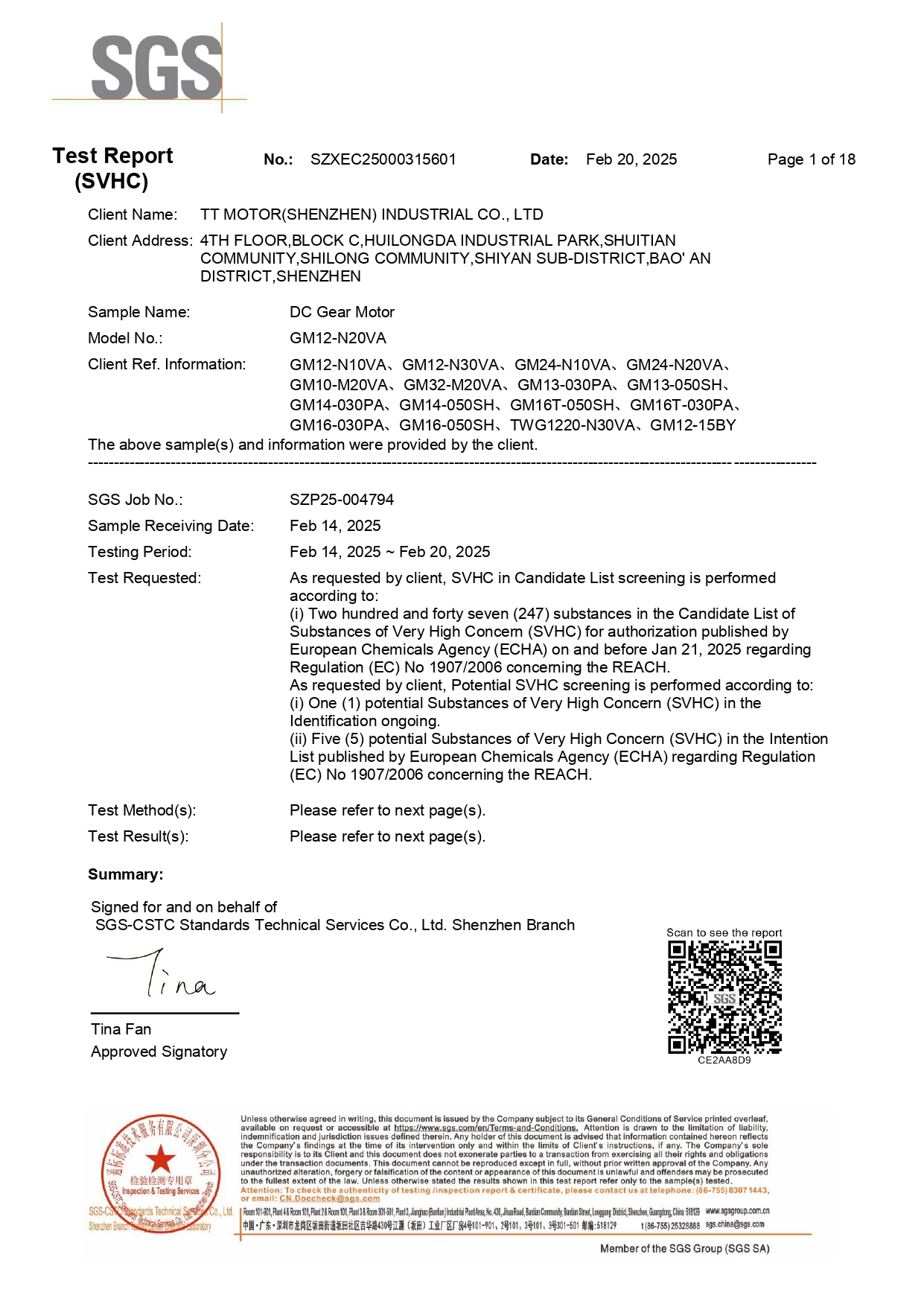
| REACH | EU REACH Regulation (EC) No 1907/2006, SVHC candidate-list substance screening | SGS | SZXEC25000315601 | GM12-N20VA and multiple DC gear-motor models of the same series; issued 2025-02-20 |
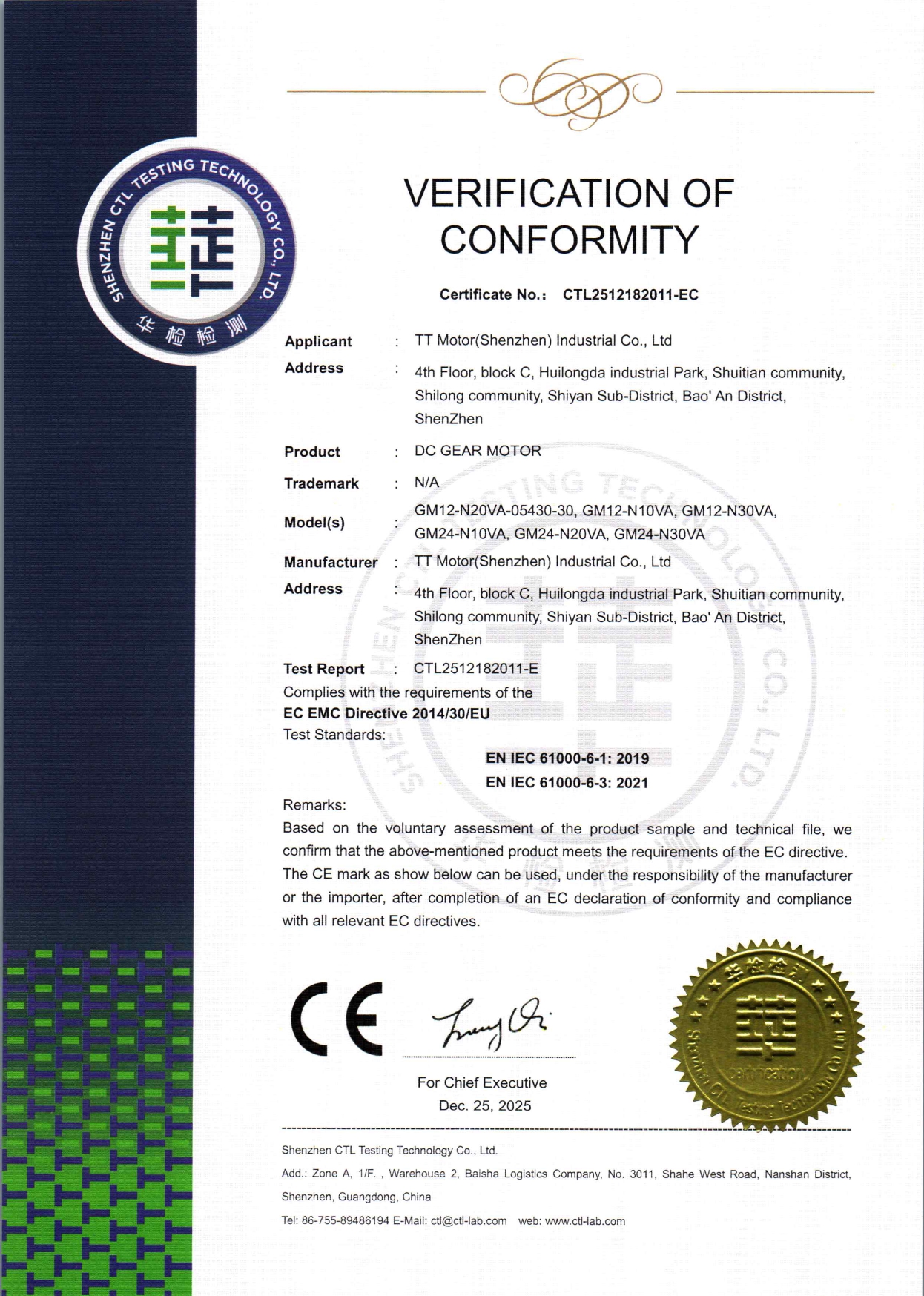
| CE (EMC) | EN IEC 61000-6-3:2021 (emissions); EN IEC 61000-6-1:2019 (immunity) | CTL | CTL2512182011-EC | GM12-N20VA, GM12-N10VA and GM12-N30VA DC gear motors; issued 2025-12-25 |
Three details in that package are worth copying into your own supplier checklist. The ISO 9001 certificate is scoped to the R&D and manufacture of micromotors, which means it covers DC gear motors and DC brushless motors rather than the company in general, and it is valid from 2026-08-21 to 2029-08-21. Each RoHS report names a specific model first and then extends to related series models, which is the wording that determines whether your part number is inside or outside the tested scope. And the REACH report is issued as incoming material documentation, so it can be filed directly into a buyer's own incoming inspection record rather than sitting in a marketing folder.
Parameter Constraints Come Before Paperwork
A certificate can only exist for a defined configuration, so the electrical and mechanical envelope has to be fixed first. In miniature motors, the envelope is defined by four variables: rated voltage, maximum rated torque at the gearbox output, output speed range, and the mounting envelope formed by motor diameter, gearbox length, shaft diameter and flange pattern. Once those four variables are locked, the model is identifiable, and a numbered certificate can be matched to it.
The voltage variable is where most first-round mismatches occur. Searches for a 12v gear motor frequently return products whose rated voltage is 2.4 V or 5 V, or whose range stops at 12 V rather than spanning it. The comparison below shows how five miniature platforms differ, and which documents apply to each.
| Model | Motor type | Rated voltage | Max rated torque | Output speed | Gearbox stages and length | Documented compliance |
|---|---|---|---|---|---|---|
| GMP36-TEC3650 | Brushless planetary gear motor | DC 12 V to 24 V | 30.0 kg.cm | 4 rpm to 1600 rpm | 1 to 4 stages; 26 / 33.5 / 40.5 / 47.5 mm | RoHS CANEC26013325501; within ISO 9001 scope |
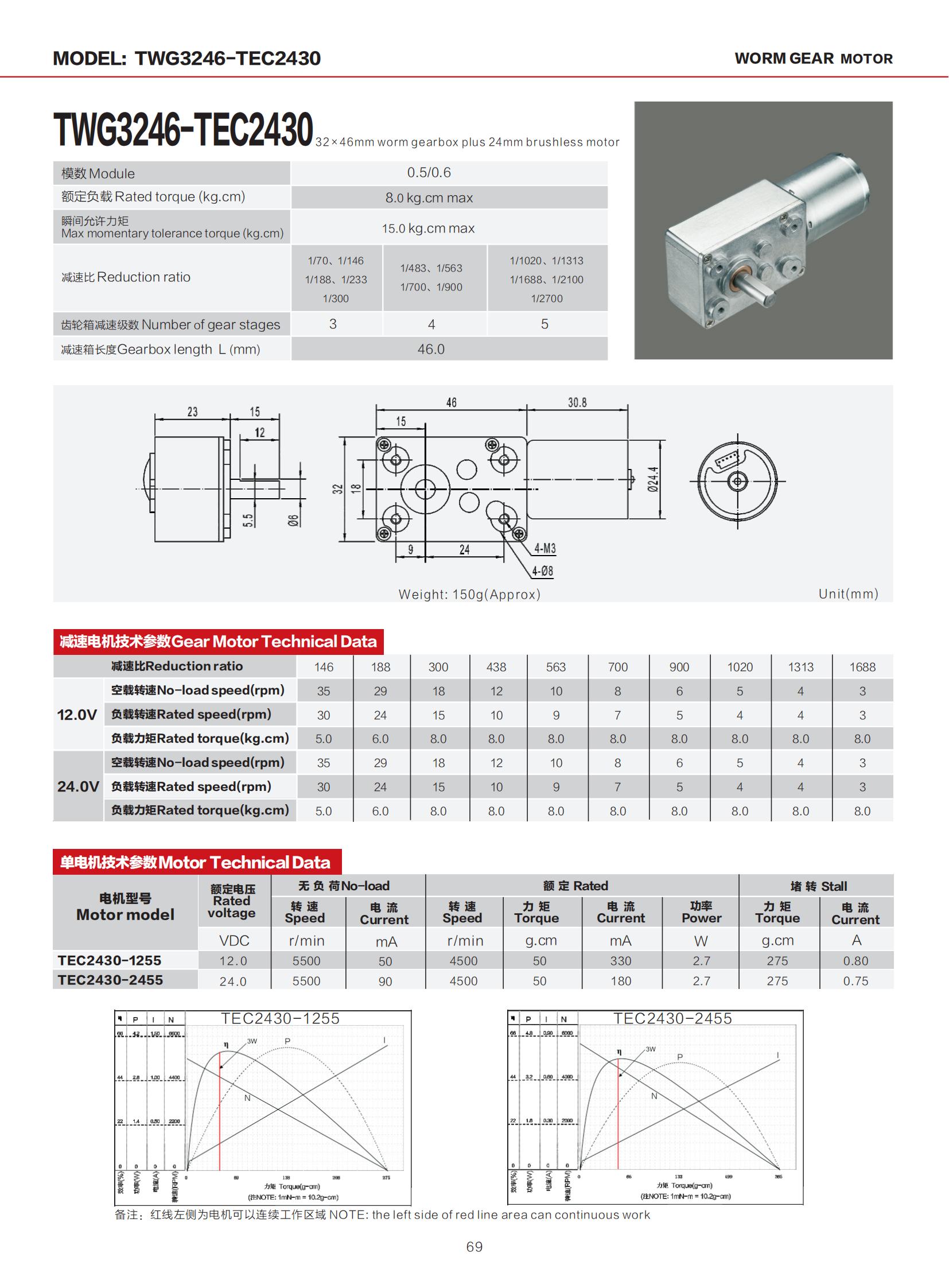
| TWG3246-TEC2430 | DC brushless worm gear motor | DC 12 V to 24 V | 8.0 kg.cm | 3 rpm to 35 rpm | 3, 4 or 5 stages; 46 mm | RoHS CANEC26013326101; within ISO 9001 scope |
| GM37-555PM | DC brush spur gear motor | DC 12 V to 24 V | 8.0 kg.cm | 5 rpm to 800 rpm | 2 to 6 stages; 19 / 21.5 / 24 / 26.5 / 29 mm | RoHS CANEC26013323201; within ISO 9001 scope |
| GMP12T-TDC1215 | DC brush coreless gear motor | DC 4.5 V to 12 V | 2 kg.cm | 8 rpm to 5000 rpm | 1 to 4 stages; 14.9 / 19.7 / 24.5 / 29.3 mm | RoHS CANEC26013325001; within ISO 9001 scope |
| GM12-N20VA | DC spur gear motor | 2.4 V or 5 V | 0.5 kg.cm | 12 rpm to 1450 rpm | 2, 4, 5 or 7 stages; 9 mm or 12 mm | RoHS CANEC26005990201; CE EMC CTL2512182011-EC; REACH SZXEC25000315601 |
Each platform carries its own design constraint. The GMP36-TEC3650 brushless planetary gear motor produces up to 30.0 kg.cm across 4 rpm to 1600 rpm, uses a 1/4 to 1/720 reduction ratio range, weighs 420 g, and provides an 8 mm solid shaft with four M3 flange holes on a 36 mm body, which makes it a candidate where positioning accuracy and transmission backlash matter. The TWG3246-TEC2430 worm gear motor combines a right-angle output with a self-locking gearbox, so no additional braking device is needed, and its 3 rpm to 35 rpm output suits slow, smooth fine adjustment rather than fast indexing. The GM37-555PM covers ten reduction ratios from 1/6 to 1/810 with a standard 37 mm outer diameter and 6-M2.5 flange holes, which simplifies drop-in replacement work. The coreless GMP12T-TDC1215 reaches up to 5000 rpm at 2 kg.cm with gearbox lengths from 14.9 mm to 29.3 mm. And the GM12-N20VA is a 2.4 V or 5 V platform with a 0.5 kg.cm rating and an all-metal precision gearbox produced by a hobbing process, typically specified for smart door locks rather than 12 V systems.
A Six-Step Verification Workflow
The following sequence converts a document package into a purchase-ready decision, and it can be run in parallel for several suppliers.
- Lock the envelope. Specify rated voltage, maximum rated torque, output speed range, and the mounting envelope. Confirm whether the application needs continuous duty or intermittent positioning, because that determines the acceptable life and duty assumptions.
- Request documents before the quotation. Ask for the quality management system certificate, the RoHS report, the REACH report and the EMC evidence, each with issuer, certificate number, referenced standard and covered model list.
- Verify at the source. Check the certificate number with the issuing body named on the report. The miniature motor range documented here uses SGS for RoHS and REACH, CTL for CE EMC, and DCI for ISO 9001, all of which can be contacted directly.
- Cross-check the scope statement against your part number. Compare the model list in the report, including the related series wording, with the exact model on your purchase order. If your model is not named and is not clearly within the series description, request an updated report rather than accepting an assurance email.
- Confirm change control. Ask what happens if a raw material, component, production equipment or process changes after approval. The verifiable answer is advance notification plus re-verification, supported by defined acceptance standards and a small-batch trial production step before mass production.
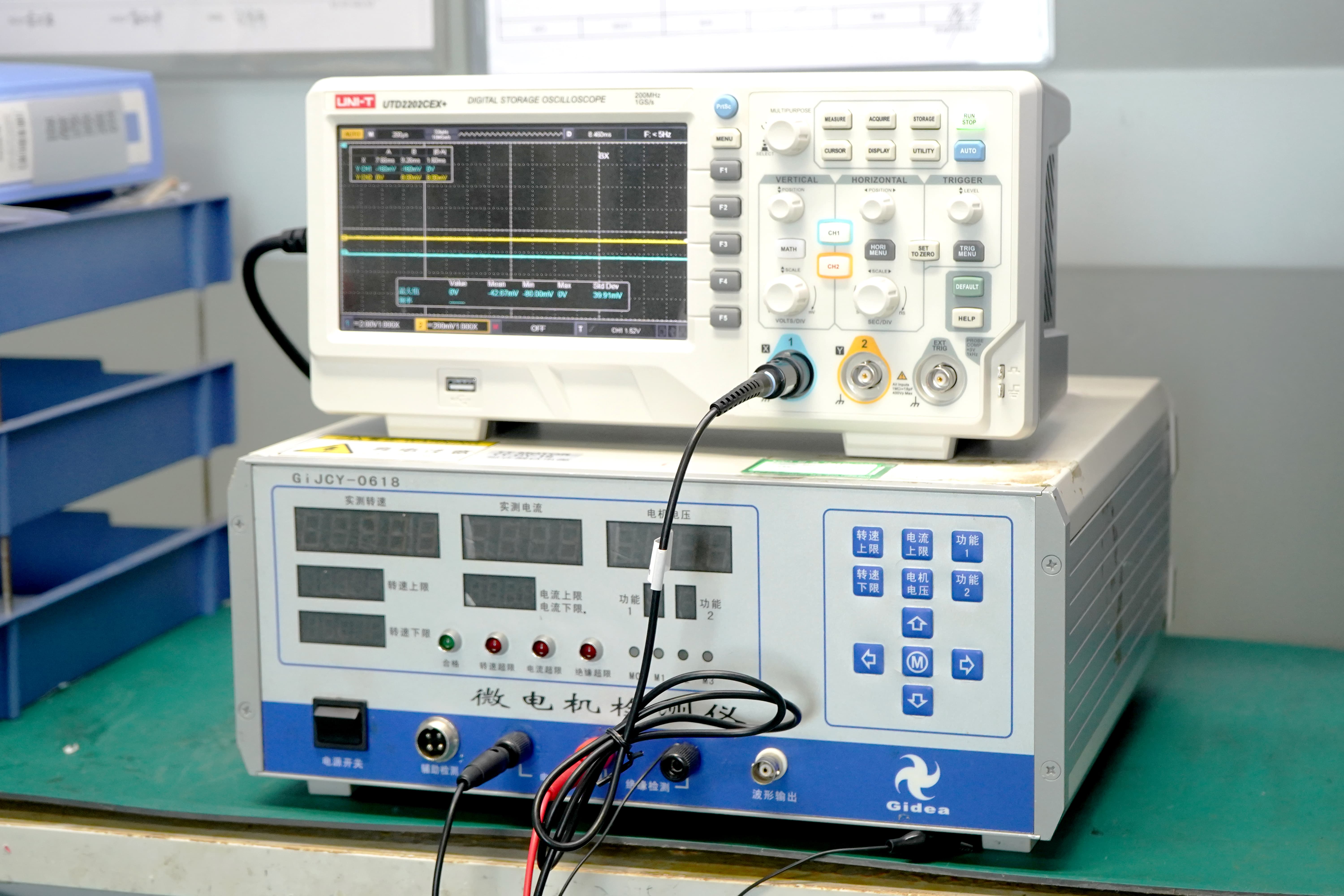
- Confirm the output quality gate. Establish whether testing is sampling-based or full inspection, and which parameters are recorded. A supplier running 100 percent testing, with equipment such as micro motor testers, life testing systems, rotor dynamic balancing machines and temperature and humidity chambers, can provide parameter data rather than statements.
Where These Motors Are Used, and Which Constraints Apply
Application context determines which certificate and which parameter matter most. Three categories illustrate the pattern, and in each case the documentation requirement follows the application rather than the motor type alone.
- Smart home and consumer devices. The working condition is low speed in limited space, with miniaturization, low noise and low power consumption as recurring requirements. Typical projects include smart curtains, robot vacuum cleaners, smart toilets, height-adjustable desks, smart refrigerators, smart trash cans, smart pet feeders and smart camera pan and tilt units. The GM12-N20VA and the TWG3246-TEC2430 both appear in this category, and the worm gear motor's self-locking function removes the need for a separate brake in adjustable mechanisms.
- Medical and laboratory equipment. The working condition is low-speed precision motion under long-term operation, with low noise, low vibration and stable output as the governing requirements. Projects include infusion pumps, syringe pumps, pipetting equipment, body fluid analyzers, urine analyzers and rehabilitation robots. The brushless construction of the TWG3246-TEC2430 is relevant here because it does not generate sparks during operation and is designed for minimal electromagnetic interference.
- Robotics and industrial automation. Robot joints require high-frequency dynamic motion with rapid start and stop, so power density, response speed and low inertia dominate the specification. The coreless GMP12T-TDC1215 addresses this through a low-inertia rotor design, while the GMP36-TEC3650 covers higher-torque joints and logistics actuators.
Documented user experience supports the same pattern. A dental instrument manufacturer in Japan uses the coreless GMP12T-TDC1215 at volumes of 500 to 2,000 units per year for micro positioning and adjustment mechanisms, with rapid response and improved control precision recorded over a three to five year relationship. A medical device manufacturer in the United Kingdom drives medical pumps at 500 to 2,000 units per year and reports stable output under long-term operating conditions with reduced maintenance frequency. A smart lock manufacturer in the United States orders 5,000 to 50,000 units per year for lock body drive and mechanical transmission, verified against high-frequency unlocking requirements. A logistics equipment company in the United States uses the GMP36-TEC3650 and GM37-555PM to drive conveyor and sorting mechanisms, with stable operation recorded under frequent start-stop cycles and load changes.
Frequently Asked Questions
Can China BLDC motor manufacturers provide CE and RoHS documentation for the exact model I order?
Yes, but availability is model-specific, and the practical test is whether the report's scope statement names the model you are buying. TT Motor's documentation shows the level of traceability worth requesting: SGS RoHS reports cover the GMP36-TEC3650 brushless planetary gear motor under CANEC26013325501, the TWG3246-TEC2430 DC brushless worm gear motor under CANEC26013326101, the GMP12T-TDC1215 coreless motor under CANEC26013325001, the GM37-555PM DC gear motor under CANEC26013323201, and the GM12-N20VA and GM24-N20VA DC gear motors under CANEC26005990201, which references the IEC 62321 series test standards. CE EMC evidence is documented for the GM12-N20VA, GM12-N10VA and GM12-N30VA DC gear motors under CTL2512182011-EC, issued by CTL. If a supplier cannot produce a numbered report for the model you are ordering, the compliance claim should be treated as unverified.
Does a CE certificate for a 12 V gear motor mean the same thing as CE for a large industrial motor?
No. CE covers different directives depending on product type and power class, so the standards cited on the certificate matter more than the CE mark itself. EU Ecodesign Regulation (EU) 2019/1781 sets minimum efficiency performance standards for motors between 0.12 kW and 1000 kW, with IE3 required from 0.75 kW to 1000 kW, and IEC 60034-30-1:2025 introduced the IE5 Ultra Premium Efficiency class in the same power class. A miniature 12 V or 24 V gear motor sits well below that range, so its compliance evidence is typically EMC, RoHS and REACH rather than efficiency class. For the GM12-N20VA, the CE documentation cites EN IEC 61000-6-3:2021 for electromagnetic emissions and EN IEC 61000-6-1:2019 for electromagnetic immunity, which is the correct reference set for a component of this type and size.
Can a supplier customize voltage, shaft or gearbox and still keep the documentation valid?
Customization scope and documentation scope have to be checked against each other. The published production parameters for this miniature motor range include OEM and ODM production with customization of shaft, encoder, gearbox, voltage, logo and speed, with a minimum order quantity of 2 pieces. RoHS and REACH reports are written against a model plus its related series, which means changes that do not alter the tested material and component set generally remain inside the tested scope, while changes that introduce different materials, components or processes require re-verification. The verifiable practice to ask for is advance notification of any change to raw materials, components or production processes, followed by re-verification before the changed parts ship. Buyers sourcing for medical or automotive programs should confirm this in writing before releasing a blanket order.
What is the minimum order quantity for a documented brushless gear motor?
The minimum order quantity published for this miniature motor range is 2 pieces, with monthly production capacity of 800,000 pieces and annual output of 8,000,000 pieces. Documentation is not tied to order size, so a small evaluation order can be supplied with the same certificate set as a production order. Unit pricing is quoted per configuration rather than from a list, because rated voltage, torque, gearbox stage count, output shaft specification and encoder or logo customization all change the bill of materials. For evaluation purposes, the fastest route is to state the required voltage, torque, speed, mounting envelope and annual quantity in a single request so that both the model and the matching certificate numbers can be confirmed together.
How long do samples take, and how do I start the evaluation?
Published lead times for this miniature motor range are 15 to 25 days for samples and 30 to 45 days for bulk production, with 100 percent testing applied to output and remote support provided after delivery. Company background information relevant to qualification includes establishment in 2006, a manufacturing area of approximately 9,000 square meters, more than 300 employees, a 35-engineer R&D team, three production plants, and an export share of about 70 percent concentrated in the EU and US markets. To begin, send the target voltage, torque, speed, mounting envelope and order quantity to sales26@ttmotor.com, or submit the request through www.ttmotor.com, and ask for a sample together with the certificate numbers that will apply to the production order.
Conclusion
For miniature brushless motors and DC gear motors sourced from China, the difference between a compliant purchase and a compliance problem almost always comes down to two things: whether the model was fixed before the certificate was requested, and whether the scope statement in that certificate names your part number. Fix the voltage, torque, speed and mounting envelope first, then request ISO 9001, model-level RoHS, REACH SVHC screening and CE EMC evidence, and verify each certificate number with the issuing laboratory. Buyers who run that sequence in the research and evaluation stage spend less time resolving documentation gaps during production ramp-up, and they enter price discussions with a specification that cannot be quietly substituted.
Next Step: Request a Sample and a Document Package
TT Motor (Shenzhen) Industrial Co., Limited manufactures miniature DC motors, brushless motors, coreless motors, planetary, spur and worm gear motors from Bao'an District, Shenzhen, serving EU and US buyers with OEM and ODM production, 100 percent output testing and model-level RoHS, REACH and CE documentation.
Send your required voltage, torque, speed and mounting envelope to sales26@ttmotor.com or call +86 180-0299-3379 to receive a sample and the matching certificate numbers. The company brochure is available for download here: TT Motor exhibition brochure (PDF).

Have Questions or Need More Details?
Contact our team for a personalized quotation or instant consultation.
Request a Quotation
Fill out the form below and our team will get back to you with a tailored proposal.
WhatsApp Direct Chat
Prefer to chat in real-time? Message us on WhatsApp for instant assistance & quick answers.
- Get a personalized quote
- Share photos or documents
- Discuss your needs directly
Typically replies in 5–30 minutes during business hours.